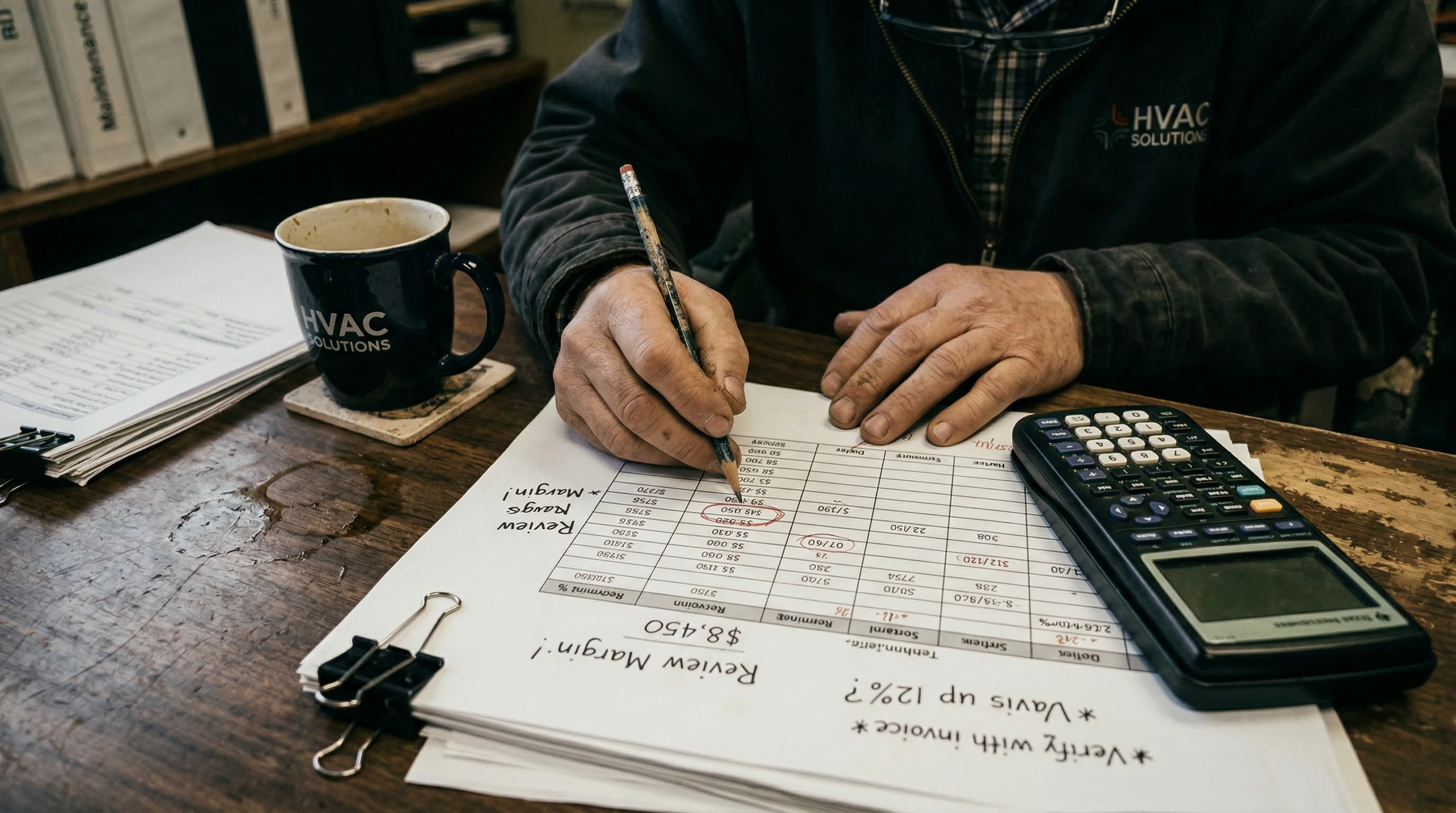
The HVAC owner I analyzed last month was spending $11,400/month on marketing.
He had no idea if it was working. His Google Ads agency sent him a report every month. Click-through rates. Impressions. Quality scores. Twelve pages of data that answered every question except the one that actually matters:
How much is this costing me per booked job?
He didn’t know. His agency didn’t tell him. And because he didn’t know, he had no way to decide if $11,400 was the right number, or if he was $4,000 over budget, or $4,000 under it. This article fixes that. By the end, you’ll know:
- What HVAC companies at different revenue levels actually spend on marketing
- The one number that tells you if your budget is right or wrong
- A simple formula to calculate your correct marketing spend in under 10 minutes
- The three places most HVAC companies leak budget without knowing it
If you want the city-specific version of this decision, the Built on Tenth Market Report shows where your local visibility gap sits, who is taking the calls first, and whether the next dollar should go into better positioning or fixing something upstream.
The Number Everyone Gets Wrong
Most articles about marketing budgets say something like: “spend 5 to 12% of revenue on marketing.” That advice is almost useless for an HVAC company. Here’s why.
A replacement company focused on system installs and a service-and-repair shop have completely different economics. The replacement company might have a $9,000 average ticket. The repair shop might average $280. The same percentage of revenue produces a wildly different cost per booked job, which changes everything about how much you should spend.
The right question isn’t “what percentage of revenue should I spend?”
The right question is: “What am I paying to get a booked job, and is that number good or bad?”
That one number, cost per booked job, is the only marketing benchmark that actually matters. The HVAC marketing benchmarks breakdown shows what top-quartile companies are actually hitting by channel and by revenue tier — useful comparison once you’ve run your own numbers.
What the Data Shows: HVAC Marketing Spend by Revenue
HVAC companies typically invest 7 to 10% of revenue on marketing, with 60 to 70% of that going to digital channels. Here’s how that breaks down by company size:
A usable marketing budget starts with paper-level math: what you spend, what you book, and what your ticket size can actually support.
| Annual Revenue | Typical Monthly Spend | % of Revenue | Avg Cost/Booked Job |
|---|---|---|---|
| Under $500K | $1,000 to $3,000 | 3 to 8% | $180 to $420 |
| $500K to $1M | $2,500 to $6,000 | 4 to 8% | $220 to $480 |
| $1M to $2M | $4,000 to $10,000 | 5 to 8% | $250 to $520 |
| $2M to $5M | $8,000 to $18,000 | 5 to 9% | $280 to $600 |
| $5M+ | $15,000 to $40,000 | 4 to 8% | $300 to $650 |
The top 25% of HVAC companies typically run at $180 to $320 cost per booked job. Companies in the bottom half are often at $500 to $900+ without knowing it. Top performers track cost per booked job by channel. They know Google Ads is producing jobs at $340 each and their LSA program is producing jobs at $180. They cut channels running above their threshold.
The Budget Formula
Step 1: Find your average ticket
Total revenue for last 12 months divided by total jobs completed. Get this from your accounting software.
Step 2: Decide your maximum cost per booked job
A healthy benchmark for HVAC is 8 to 12% of average ticket. If your average ticket is $1,800, your maximum cost per booked job should be $144 to $216. Replacement-heavy shops with $6,000+ tickets can afford $480 to $720 per booked job. Service-heavy shops at $350 average need to stay under $42.
Step 3: Find your current close rate
Of every call that comes in, what percentage turns into a booked, completed job? Most HVAC companies believe this is 35 to 45%. When actually tracked, it’s usually 22 to 32%.
Step 4: Calculate calls needed
How many jobs do you want to book per month? Divide by your close rate. Example: 80 jobs divided by 28% close rate equals 286 calls needed per month.
Step 5: Calculate your max monthly budget
286 calls multiplied by your cost per call threshold equals max budget. If you’re paying $35 per call and need 286 calls, that’s $10,010/month max budget.
The marketing cost calculator runs this formula for your actual numbers in about four minutes. Worth doing before you adjust any channel spend.
The budget conversation gets more useful when marketing numbers sit next to phone performance and dispatch reality.
The 3 Places HVAC Companies Leak Marketing Budget
Leak 1: Phone Handling
The average HVAC company answers roughly 68% of inbound calls. That means 32 out of every 100 calls they paid to generate go unanswered. At $35 cost per call and 300 calls/month, that’s $3,360/month spent generating calls nobody answers.
Even among answered calls, booking rates vary wildly. Top performers book 65 to 75% of answered calls. Industry average is closer to 40 to 50%. That gap on 300 calls/month is the difference between 90 booked jobs and 150. Same budget. Same ads. Completely different revenue.
This is a phone operations problem, not a marketing problem. The full breakdown of what slow answer rates and weak booking rates actually cost per year is in the CSR performance analysis. The numbers are specific and the math carries directly to HVAC.
The fix: Track your answer rate and booking rate separately. Both numbers should live on a dashboard your CSR manager sees every day. The phone performance calculator shows you the dollar cost of your current answer and booking rates.
Leak 2: Wrong Channel Mix
Not all call sources are equal, and the most popular channels are often the most expensive. The average cost per click for HVAC keywords hit $32.77 in 2025. Here’s how channels compare:
| Channel | Typical Cost Per Call | Notes |
|---|---|---|
| Google LSAs | $25 to $55 | Highest intent, best quality |
| Google Ads (search) | $35 to $90 | Quality varies by campaign setup |
| Angi / HomeAdvisor | $45 to $120 | Shared leads, heavy price shoppers |
| Organic SEO | $8 to $25 | Slow to build, very high ROI at scale |
| Google Business Profile | $5 to $18 | Often ignored, extremely high intent |
| Direct mail | $30 to $80 | Works best for maintenance agreements |
| Referrals | $0 to $25 | Highest close rate of any source |
Most HVAC companies spending $8,000+/month are over-indexed on Google Ads and under-invested in LSAs and their own GBP optimization. Moving $2,000/month from broad Google Ads to LSAs typically reduces cost per call by 30 to 40%. The LSA setup guide shows how to get that channel live correctly, and the Google Ads campaign structure breakdown shows why broad search campaigns usually cost more than owners think.
Leak 3: No Measurement System
If you can’t answer these four questions right now, you have a measurement problem:
- What’s my cost per booked job this month?
- Which channel produced the most jobs last month?
- What’s my average ticket by channel?
- What’s my close rate on calls from Google Ads vs. LSAs vs. Angi?
If you’re relying on your agency to tell you the answers, you’re getting the version they want you to see. Track calls by source and jobs by source separately, in your own system.
How to Tell If Your Agency Is Reporting the Right Numbers
Most HVAC owners judge their agency by the report they receive. The problem is the report is built by the agency. If there’s a conflict between what looks good for the agency and what’s true for your business, you already know which direction the report goes.
Three specific things to check:
They’re reporting leads, not booked jobs. Form fills and calls are not booked jobs. An agency that shows you “320 leads this month” without telling you how many became booked, completed jobs is hiding the number that actually matters. Ask for booked jobs, and if they can’t pull that from your system, that’s a gap to fix.
They’re reporting average cost per click, not cost per booked job. A $28 average CPC looks great. A $620 cost per booked job does not. You need to tie ad spend to completed jobs through your CRM or scheduling software. If the agency hasn’t helped you build that bridge, they’re optimizing for the metric they can control.
They’re not separating channels. A blended cost per lead across Google Ads, LSAs, and GBP hides which channel is actually working. If one channel is producing jobs at $180 and another at $740, the blended number might look acceptable while one of those channels is burning money. Demand channel-level cost per booked job, every month.
This is not about firing your agency. Some agencies are genuinely good. It’s about holding any vendor to the number that connects to your business, not theirs.
Seasonal Budget Strategy: Slow Season vs. Busy Season
Most HVAC companies spend the same on marketing every month. That’s usually wrong.
In busy season (typically May through August, and again in December through January depending on your region), demand exceeds your capacity. Adding marketing spend does not add revenue if your dispatch board is already full and you’re turning down calls. During peak weeks, the better move is to maintain your baseline spend and invest the saved budget in booking rate improvement, not more call volume.
In slow season, the math flips. If your answer rate is 90% and your booking rate is 70%, the constraint is calls, not phone ops. That’s when adding spend on the right channels actually compounds. Slow season is also when maintenance agreement campaigns pay off because you’re locking in revenue that smooths out next year’s slow season before it starts.
A rough allocation that works for most $1M to $3M HVAC companies:
- Busy season: hold spend at your baseline, focus on booking rate
- Shoulder season (March to April, September to October): increase by 15 to 20% to capture demand before the peak
- Slow season: run campaigns specifically for maintenance agreements and system evaluations rather than pure service calls
The companies that figure this out stop thinking about marketing as a monthly cost and start thinking about it as a dial they turn based on what the business actually needs right now.
What “Good” Looks Like at Different Revenue Levels
Here’s a benchmark table based on top-quartile HVAC companies. These are the numbers you’re aiming for:
| Metric | Under $1M | $1M to $3M | $3M to $5M |
|---|---|---|---|
| Marketing as % of revenue | 6 to 9% | 5 to 8% | 4 to 7% |
| Cost per booked job | $180 to $320 | $220 to $380 | $260 to $420 |
| Phone answer rate | 85%+ | 88%+ | 90%+ |
| Booking rate (answered calls) | 58%+ | 62%+ | 65%+ |
| Revenue per marketing dollar | $9 to $14 | $11 to $17 | $13 to $20 |
The full breakdown of what separates top performers from the middle on each of these metrics is covered in the HVAC marketing benchmarks analysis.
When to Increase Your Marketing Budget
More spend is only the right answer in a specific situation: your cost per booked job is at or below your threshold, your phone operation can handle more call volume, and you have the technician capacity to run more jobs.
If all three are true, the next dollar you spend on the right channels will produce a job at a profitable cost. Scale it.
If any of those three are broken, adding budget makes the problem worse. More calls into a phone operation that books 35% of answered calls just means more money wasted per booked job. More jobs than your technicians can handle means quality problems and callback costs.
A practical signal: if your cost per booked job has been stable for two consecutive months and you have open capacity on the dispatch board, that’s the green light to add 20 to 25% more to your top-performing channel and measure what happens over the next 30 days.
A signal to cut instead: if your cost per booked job is rising month over month while total spend is flat, something changed in the channel, either competition increased, your review profile weakened, or your phone ops slipped. Find the cause before adding budget.
The Real Answer to “How Much Should I Spend?”
Spend exactly as much as produces a job at or below your cost-per-job threshold, and not a dollar more. If your threshold is $300 per booked job and you’ve found channels producing jobs at $220, spend more on those channels. If you’re spending $500 per booked job on a channel and can’t fix it, cut it no matter what your agency says.
At what point does the next dollar I spend stop producing jobs at a price that makes sense? That’s your ceiling. Everything below it is the right budget. Everything above it is overhead you’re funding for your agency.
If you want help deciding whether the problem is budget, channel mix, or local market position, see the sample and pricing for the Built on Tenth Market Report. If you want more benchmark context first, see all HVAC Market Insights.
What to Do This Week
- Pull last month’s numbers: total marketing spend, total calls received from all sources, total jobs booked. Calculate cost per booked job.
- Ask your agency for a channel breakdown: cost per call by source. If they can’t provide it, that tells you something.
- Check your phone answer rate: most phone systems or call tracking tools can pull this. If you don’t have call tracking, that’s the first thing to add.
- Use the Marketing Cost Calculator to benchmark your numbers against HVAC industry data. It takes about 4 minutes.
Frequently Asked Questions
What’s the average marketing budget for an HVAC company?
HVAC companies typically invest 7 to 10% of revenue on marketing, with 60 to 70% going toward digital channels. For a $2M company, that’s roughly $11,000 to $16,000/month. However, the right number depends on your average ticket, close rate, and cost-per-job threshold, not a fixed percentage.
Should HVAC companies use a percentage of revenue for marketing budgets?
It’s a useful starting point but not precise enough to optimize against. Two companies at $2M revenue can have completely different optimal budgets if one has a $500 average ticket and the other has a $4,000 average ticket. Use cost per booked job as your primary benchmark.
What’s a good cost per booked job for HVAC?
For service and repair work with a $250 to $600 average ticket, aim for $180 to $320 per booked job. For replacement work with a $5,000 to $12,000 average ticket, $400 to $800 per booked job is reasonable. The target is 8 to 12% of your average ticket.
How much do top HVAC companies spend on Google LSAs?
Most HVAC companies find LSAs deliver the best cost per call of any paid channel, typically $25 to $55/call in most US markets. Top performers allocate 30 to 50% of their paid media budget to LSAs before investing heavily in traditional Google Ads.
Should I cut marketing spend in slow season?
Not automatically. Slow season is when your call volume drops but your phone operation usually still has capacity. If your cost per booked job is within range, slow season can actually be the right time to increase spend on maintenance agreement campaigns. What you should cut is any channel that was already running above your cost-per-job threshold in busy season. Slow season just makes a broken channel’s numbers worse.
How do I know if my marketing budget is too high?
Your cost per booked job is the signal. If it’s consistently above 12 to 15% of your average ticket and you’ve already fixed your phone answer rate and booking rate, your budget is either allocated wrong or concentrated on channels that don’t work in your market. Cut the channels running above threshold before cutting total spend.
What should I ask my HVAC marketing agency for each month?
Ask for three numbers: cost per booked job by channel, total booked jobs by channel, and phone answer rate. If they can’t produce booked jobs by channel because they don’t have access to your scheduling software, that’s the first integration to build. An agency reporting only clicks and impressions is not reporting on your business. They’re reporting on their campaign.
How much should a new HVAC company spend on marketing?
Companies under $500K revenue generally need to stay between $1,000 and $3,000/month with the budget concentrated on Google LSAs and GBP optimization before paid search. The priority at that stage is building reviews and establishing local visibility, not broad ad spend. Paid channels that require volume and testing to optimize are harder to use profitably when the base is small.
What’s the ROI on HVAC marketing?
Top-quartile HVAC companies generate $11 to $17 in revenue for every $1 spent on marketing. The range across the industry is much wider, from $4 to $20+, depending on average ticket, phone performance, and channel mix. Revenue per marketing dollar is a useful internal benchmark to track month over month, even if the absolute number varies by company type.