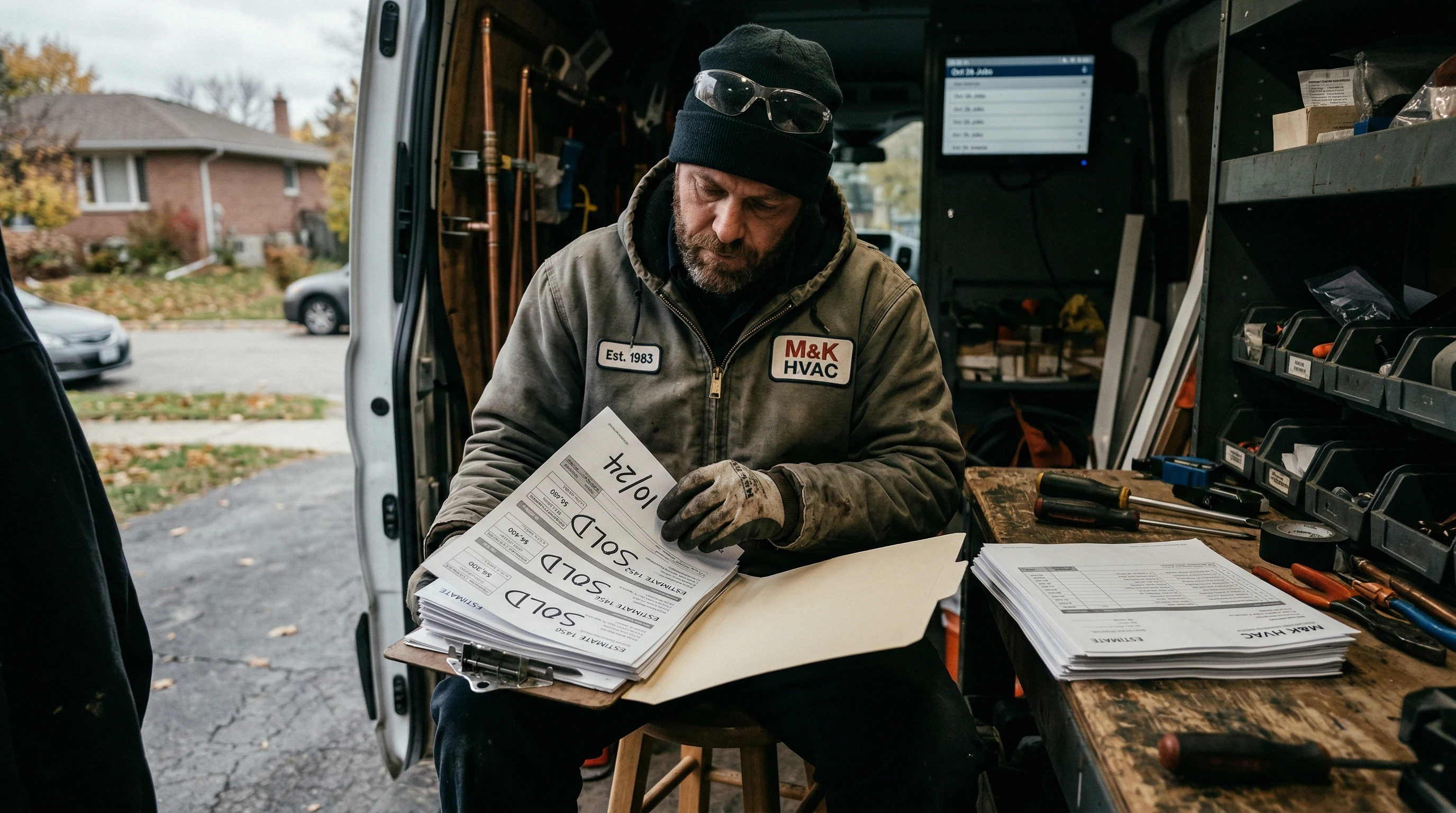
HVAC close rate is the percentage of estimates or service calls that convert to a completed, paid job. It is one of the most cited metrics in HVAC operations — and one of the most consistently misread. Most owners track a single blended close rate across all call types. That number obscures more than it reveals.
A company with a 68% overall close rate might have a 97% repair close rate and a 32% replacement close rate. The blended number looks healthy. The replacement business is quietly bleeding revenue. A 10-point improvement in replacement close rate on 20 estimates per month at a $9,000 average ticket is $18,000 in additional monthly revenue — and most HVAC owners don’t know which number is the problem because they only track one.
This article breaks HVAC close rate into the categories that matter and gives you benchmarks that are actually useful for diagnosing where revenue is leaking.
Why a Blended HVAC Close Rate Is Misleading
Every call type has a different buying dynamic. Lumping them together produces a number that does not correspond to any real operational decision.
A homeowner who calls because their AC stopped working in July and you diagnose a failed capacitor is going to accept that repair at a very high rate. The urgency is high, the cost is relatively low, and the alternative is suffering through the heat. That is a near-captive close scenario.
A homeowner who gets a replacement estimate for a 12-year-old unit that is still technically working is making a discretionary capital decision. They are likely getting two or three quotes. They may delay. They may decide to wait until the system fails. That conversation has a completely different dynamic, and expecting it to convert at the same rate as an emergency repair is not realistic.
When you track both in one number, you lose the ability to see which one is the problem.
HVAC Close Rate Benchmarks by Call Type
These ranges reflect what well-run HVAC operations in the $1M to $5M revenue range typically achieve. They are reference points for diagnosing whether your performance in each category is inside or outside a normal range.
Maintenance and Tune-Up Close Rate: 95% to 99%
A homeowner who scheduled a tune-up is already bought in. The only close failures here are usually scheduling issues, payment friction, or a technician recommending an unexpected add-on. If your tune-up close rate is below 90%, the problem is in appointment-setting or confirmation, not field execution.
Emergency Repair Close Rate: 85% to 95%
High urgency compresses the decision window. The homeowner needs the system working. Price objections happen but are less likely to produce no-decisions than in non-emergency scenarios. Close rates below 80% on emergency calls usually signal a pricing problem or communication problem, not a demand problem.
Non-Emergency Service and Repair Close Rate: 60% to 80%
These are calls where the system is working but underperforming, or where a technician has diagnosed a problem the homeowner has time to think about. The homeowner has options and time. This is where flat-rate pricing consistency and options presentation matter most.
Replacement Estimate Close Rate: 30% to 55%
This is the most important close rate to track separately. The bottom of that range is where most HVAC companies live. The top is where companies with consistent financing offers, clear options presentation, and structured follow-up tend to land. A 10-point improvement in replacement close rate on 20 estimates per month at a $9,000 average ticket produces $18,000 in additional monthly revenue.
| Call Type | Benchmark Range | Key Driver |
|---|---|---|
| Maintenance / Tune-Up | 95% – 99% | Appointment confirmation process |
| Emergency Repair | 85% – 95% | Pricing consistency |
| Non-Emergency Repair | 60% – 80% | Options presentation + flat-rate pricing |
| Replacement Estimate | 30% – 55% | Financing + follow-up + options |
What an HVAC Close Rate Above 75% Actually Means
There is a benchmark in the opposite direction worth knowing. If your overall close rate is consistently above 70% to 75% across all call types, your services are likely underpriced.
When you close almost every estimate, it means you are rarely losing on price. That sounds good. It usually means you could raise prices and still close at a healthy rate. The revenue left on the table from underpricing every job is often larger than most owners assume.
A healthy replacement close rate in the 35% to 55% range means you are competitive but not desperate. Companies closing 80% of replacement estimates are almost certainly giving away margin they could be keeping.
Three Factors That Move HVAC Replacement Close Rate
Replacement estimates are where close rate improvement has the most dollar impact. Here are the three operational levers that the data shows matter most.
1. Financing Availability and Timing
ACCA data shows that contractors who never offer financing close replacement business where 50% of sales are base-model, entry-level systems. Contractors who consistently offer financing see that base-model percentage drop to 35%. Customers who might otherwise delay or decline find a monthly payment easier to commit to than a five-figure check.
Contractor survey data shows that close rates can move from 77% to 83% when financing is introduced consistently and early in the conversation. The framing matters: “This system costs $11,400” and “This system is $189 per month with approved credit” are two different conversations, even if they describe the same purchase.
2. Options Presentation (Good, Better, Best)
Customers who are presented with only one option have a binary decision: buy or don’t buy. Customers presented with three options are choosing between options — a fundamentally different decision state. Options presentation alone, without any change in pricing or products, increases average ticket and reduces no-decision outcomes.
The number of options presented per call is a leading indicator for both average ticket and close rate. If your technicians present one option on most replacement calls, that is the first place to look.
3. Speed to Follow-Up on Open Estimates
Responding to a lead within five minutes increases conversion by up to 400% compared to waiting an hour or longer. The same dynamic applies to replacement estimates. Most estimates that don’t close within 48 hours are not lost to a competitor — they are lost to inertia. The homeowner thought about it, did not hear back, and stopped thinking about it.
A structured follow-up cadence — text or call at 24 hours, again at 48 hours — recovers a meaningful percentage of delayed decisions. For high-ticket replacement estimates above $8,000, a personal call from a sales lead or owner at the 48-hour mark is especially effective.
The Estimate Follow-Up Calculator shows what an improvement in your follow-up rate is worth in dollar terms based on your current estimate volume and average ticket.
How Close Rate Connects to HVAC Revenue Per Truck
Close rate and revenue per truck are not independent metrics. They multiply together.
A technician running 4 replacement estimate calls per day with a 35% close rate closes 1.4 calls. The same technician with a 50% close rate closes 2.0 calls. On a $9,000 average ticket, that is $5,400 per day in additional revenue — without changing call volume, routing, or hours.
This is why dispatch optimization alone captures only part of the available improvement. Dispatch gets trucks to jobs. Close rate determines how much revenue each job produces. Both levers matter, and fixing one without addressing the other leaves revenue on the table.
How to Diagnose Your HVAC Close Rate by Call Type
If you haven’t been tracking close rate by call type, start now. The data you need is already in your job management software. Tag calls by type and run close rate separately for each category.
Emergency repair close rate below 80%: Look at pricing consistency. Are technicians quoting the same repair at different prices depending on the customer? Flat-rate pricing solves most of this.
Non-emergency repair close rate below 60%: Look at options presentation. Are technicians presenting one option or three? Are they explaining the cost of waiting, not just the cost of the repair?
Replacement close rate below 35%: Look at financing availability, follow-up process, and options presentation simultaneously. All three usually need attention.
Replacement close rate above 65%: Look at your pricing. You are likely leaving margin on the table.
Most field service platforms — ServiceTitan, Housecall Pro, Jobber — support custom tagging and report filtering by call type.
How Market Position Affects HVAC Close Rate
Close rate does not exist in isolation. It is influenced by your market position, your competitors’ behavior, and the trust your brand carries before a technician arrives.
A company that dominates the local map pack with 200+ verified Google reviews walks into replacement conversations with a trust advantage over a company with 18 reviews and a position-6 ranking. The homeowner has likely already researched the company before the technician arrived. That research shapes their willingness to commit.
This is one of the less obvious reasons why local visibility work directly affects sales economics. The Built on Tenth Market Diagnostic shows you exactly where you stand relative to the competitors your customers are comparing you against — and how that positioning may be affecting your ability to hold price and close estimates.
Check Your Estimate Follow-Up Rate
Most HVAC operators don’t track follow-up speed on open estimates. The Estimate Follow-Up Calculator shows you what an improvement in your follow-up rate is worth based on your current estimate volume and average ticket.
Run the Estimate Follow-Up Calculator →
Get the Full Competitive Breakdown
Close rate is affected by market position. The Built on Tenth Market Diagnostic compares your business against the top 3 competitors in your market across Google Maps signals, website conversion, call responsiveness, and marketing activity. Delivered in writing within 5 days. $200 flat. No calls, no retainer.
Frequently Asked Questions
What is a good HVAC replacement close rate?
A 35% to 55% close rate on replacement estimates is the normal operating range for well-run HVAC companies in the $1M to $5M revenue range. Below 30% suggests a problem with follow-up, financing availability, or options presentation. Above 65% consistently suggests replacements are underpriced.
Does financing really improve HVAC close rates?
Yes. ACCA data and contractor surveys consistently show that offering financing early and consistently moves close rates on replacement estimates by 6 to 15 percentage points depending on the market and price point. Financing also shifts customers toward higher-tier systems rather than base models, increasing average ticket.
What does a high HVAC close rate mean?
An overall close rate consistently above 70% to 75% across all call types typically signals underpricing. When almost every estimate closes, the business is rarely losing on price — which means prices could be raised while still closing at a healthy rate. The revenue left on the table from systematic underpricing is often larger than owners assume.
How do I track close rate by call type in ServiceTitan or Housecall Pro?
Tag each job with a call type (maintenance, emergency repair, non-emergency repair, replacement estimate) at dispatch or completion. Then run separate close rate reports for each category. Both ServiceTitan and Housecall Pro support custom tagging and filtered reporting. Jobber offers similar functionality.
How fast should HVAC companies follow up on open estimates?
Research shows that responding within five minutes increases conversion by up to 400% compared to waiting an hour. For HVAC replacement estimates, a structured follow-up at 24 hours and again at 48 hours recovers a meaningful percentage of delayed decisions. For estimates above $8,000, a personal call from a sales lead or owner at the 48-hour mark is especially effective.
What is the average HVAC service call close rate?
Emergency repair calls typically close at 85% to 95% because urgency compresses the decision window. Non-emergency repair calls close at 60% to 80%, where the homeowner has time to consider options. Maintenance and tune-up calls close at 95% to 99% because the homeowner is already committed to the appointment.
How does options presentation affect HVAC close rate?
Presenting three system options (good, better, best) instead of one changes the buyer’s decision from “buy or don’t buy” to “which one do I choose” — a fundamentally different decision state. Options presentation alone, without pricing or product changes, has been shown to increase average ticket and reduce no-decision outcomes on replacement estimates.
Built on Tenth is an independent HVAC market research platform. We sell written diagnostic reports to HVAC operators. We do not sell advertising, do not take referral fees, and do not work for any of the companies discussed in this article.