Pull the last 30 days of invoiced jobs from your system. Find five instances where two different technicians handled the same repair — capacitor replacement, contactor swap, refrigerant recharge, thermostat install. Compare what each one charged.
Most HVAC owners who do this find a $60 to $120 spread on the same job. Sometimes more.
That spread isn’t caused by different parts costs. It’s caused by techs quoting from memory — their own sense of what feels fair, what the customer seems like they can afford, or what they’ve charged in the past without being corrected. Every time the lower number gets used, margin disappears. Multiply that by 200 service calls per month across a five-truck operation and the annual revenue difference runs into six figures.
HVAC companies using flat-rate pricing typically see 15 to 20% higher revenue per service call compared to time-and-materials or memory-based pricing, according to data from Build-Folio and Buildfolio’s HVAC flat rate analysis. That improvement doesn’t come from charging more for the same work — it comes from charging consistently what the work is actually worth, every time, without variation by technician.
This article covers why pricing inconsistency happens, how flat-rate pricing closes the gap, how to build a price book that holds up in the field, and the connection between pricing discipline and the revenue-per-truck number that determines whether your operation is actually scaling.
If you are trying to figure out whether underpricing is the main leak or whether your market position is also suppressing call volume before pricing even enters the picture, the Built on Tenth Market Report gives you the local demand side of that diagnosis.
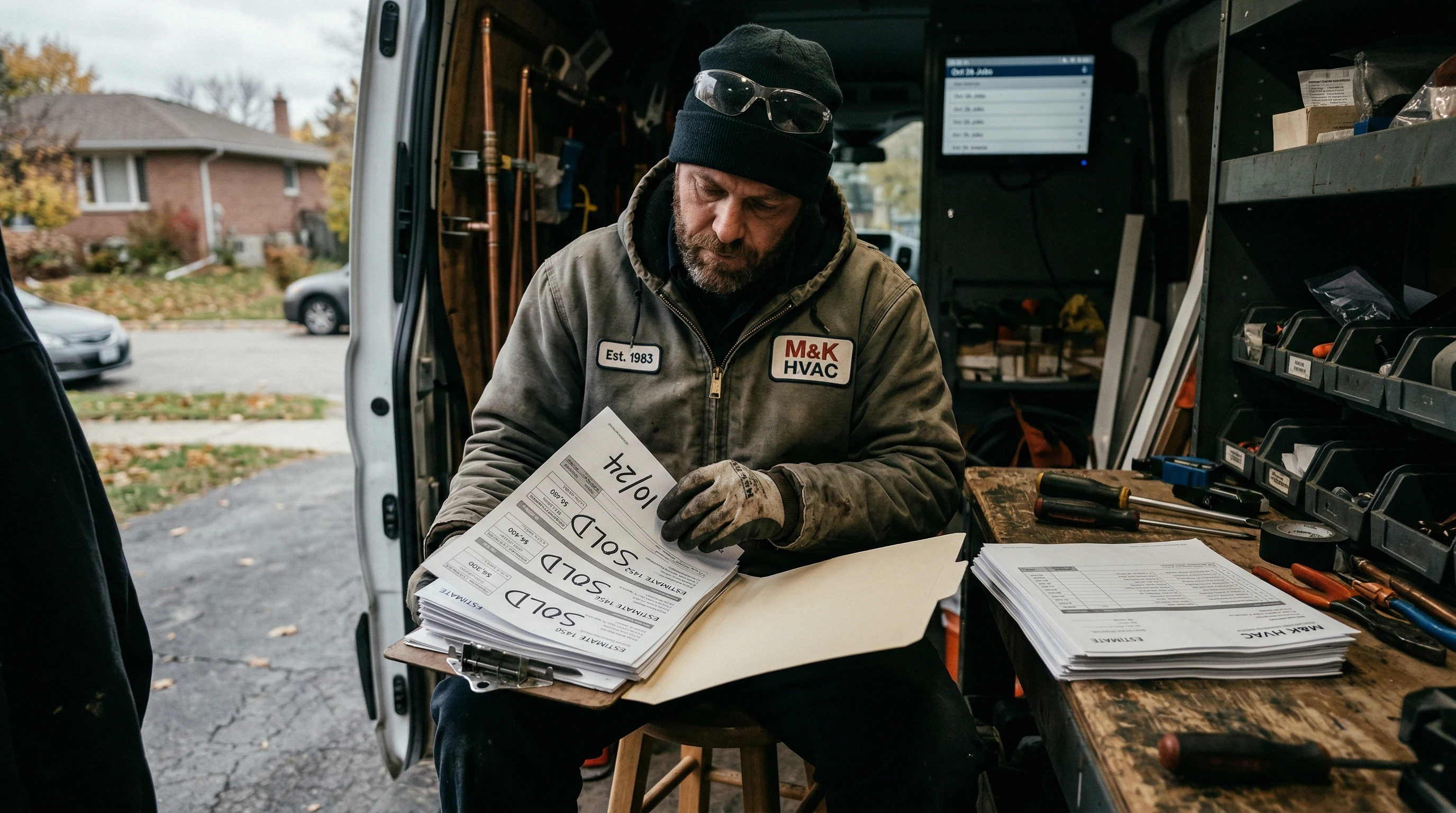
Flat-rate HVAC pricing gets more accurate when the book is built from real service-ticket history instead of memory or guesswork.
The Three Problems Flat-Rate Pricing Solves
Most HVAC owners know their time-and-materials approach has problems. The problems are usually described as “techs underbidding” or “pricing is inconsistent.” Both are symptoms of three structural issues that flat-rate pricing addresses directly.
Problem 1: Inconsistent Pricing Across Technicians
When techs quote from experience rather than a price book, you get price variation by person. Your best, most experienced tech knows what jobs cost and prices them confidently. Your newest tech prices conservatively — unsure of the right number, worried about price objections, defaulting to what feels safe. Your middle-skill techs land somewhere in between.
The result is that identical jobs get quoted at $240, $310, and $385 depending on who responds to the dispatch. Customers who got the $240 quote and later compare notes with a neighbor who got the $385 quote have a poor experience. Customers who got the $385 quote from a new tech feel overcharged. And your accounting shows wildly inconsistent margins by job type that don’t tell you anything useful.
A price book eliminates this. Every capacitor replacement is $385. Every contactor swap is $295. Every blower motor is $485. The tech doesn’t decide — they look up the job, confirm the price with the customer, and proceed. Your average ticket stops varying by personality and starts reflecting your intended pricing.
Problem 2: Fast Techs Are Penalized Under Time-and-Materials
Under hourly billing, a technician who completes a repair in 45 minutes generates less revenue than one who takes 90 minutes. You’re billing for time, not for outcome — which means your most skilled, efficient technicians are your lowest-revenue producers.
This creates a misalignment ServiceTitan has documented across HVAC operations: the best techs, who complete jobs faster and with fewer callbacks, generate less per job than slower techs. If you’re paying the same hourly wage to both, your best tech is your most expensive from a wage-to-revenue ratio perspective.
Flat-rate pricing inverts this. A tech who completes a $385 capacitor replacement in 30 minutes and moves to the next job generates more revenue per hour than one who takes 75 minutes. Efficiency becomes the financial advantage — for the company and for the tech if you tie any performance incentives to revenue generated.
Problem 3: Customers Watch the Clock, Not the Work
Hourly billing puts the customer in an adversarial relationship with your technician’s pace. They’re watching how long things take. They’re mentally calculating the bill. They may feel like the tech is stretching the job.
Flat-rate pricing removes that dynamic. The customer knows the price before work starts. They approved it. They stop watching the clock and start watching the outcome. ServiceTitan’s pricing guide describes this as a direct improvement to customer experience — the customer is buying a result, not time. That psychological shift produces higher close rates on quoted work and higher willingness to approve additional services identified during the visit.
How the Pricing Gap Shows Up in Revenue Per Truck
The connection between pricing consistency and revenue per truck is direct. If you haven’t read the HVAC revenue per truck analysis, the short version: top-performing HVAC companies generate $180,000 to $280,000 per technician annually. Industry average is $120,000 to $180,000.
One of the five variables that drives that gap is average ticket. A technician running four jobs per day at $220 average ticket generates $880 in daily revenue. The same technician at $310 average generates $1,240. Same job count, same hours, $360 difference per day — or $90,000 per year per technician.
Pricing inconsistency is usually the primary driver of average ticket gaps between technicians. When you pull revenue per tech and find a 30 to 40% spread between your highest and lowest producer, check average ticket per technician alongside job count. If the lower-producing tech is running the same number of jobs as the higher-producing one, the gap is almost always in pricing — not in effort, skill, or job mix.
A price book collapses that spread by removing the variable. The tech who was quoting $240 for a capacitor replacement now quotes $385 because the book says $385. Their average ticket comes up. Your revenue per truck comes up. No new marketing, no additional call volume required.
How to Build a Price Book That Actually Gets Used
Most price books fail in the field for the same reasons: they’re built once and never updated, they don’t cover enough job types, or the techs don’t trust the prices because they seem disconnected from actual costs.
Here’s how to build one that holds.
Step 1: Start with your loaded labor rate
Your loaded labor rate is not what you pay your technician. It’s the full cost of that technician per hour — wages, payroll taxes, health insurance, truck cost, fuel, tools, and a share of overhead.
A technician paid $28/hour typically costs the company $55 to $70/hour fully loaded once all carrying costs are included. FieldEdge’s 2025 analysis found that a tech paid $25/hour costs the business $92.81 per billable hour once labor burden, overhead, and profit margin are added. That’s the floor your pricing has to clear before generating any margin.
Most HVAC companies using time-and-materials billing charge $75 to $150/hour. If your tech costs $90/hour fully loaded and you’re billing $95/hour, you’re generating $5/hour in net margin before parts — which isn’t a business, it’s charity work with more paperwork.
Your loaded labor rate is the starting number every flat-rate price is built from.
Step 2: Use average job time, not best-case time
Every flat-rate price covers the average time to complete that job type, not the time your best tech takes on a clean install with all the right parts on the truck.
Pull your last 90 days of job data. For your 20 most common repairs, calculate the average time from dispatch arrival to job complete. Include diagnosis time, parts lookup, the repair itself, and close-out paperwork. That average — not the fastest time, not the slowest — is the labor time your flat rate is built on.
If you use best-case time, you’ll be underwater on every job that goes slightly wrong. If you use worst-case time, your prices will be uncompetitive. Average time gives you a price that’s profitable on most jobs and acceptable on difficult ones.
Step 3: Apply consistent parts markup
Parts markup is where the most margin leaks in HVAC pricing outside of labor rate. The standard approach:
- Commodity parts (capacitors, contactors, filters, belts): 2.5x to 3.0x cost
- Mid-tier components (motors, boards, sensors): 2.0x to 2.5x cost
- High-cost components (compressors, heat exchangers): 1.5x to 2.0x cost (lower markup percentage, but higher absolute margin given the part cost)
Most residential HVAC targets 55 to 65% gross margin on repairs. If your repair margins are consistently below 50%, the most common causes are markup that’s too low on commodity parts, labor rates that don’t cover overhead, or both.
Step 4: Cover your 40 to 60 most common jobs first
Start with the repairs your company runs most frequently. Capacitor replacement. Contactor replacement. Blower motor. Thermostat install. Refrigerant recharge. Coil cleaning. Diagnostic fee. Those 20 to 30 jobs represent 70 to 80% of your service volume.
Build prices for those jobs first. Validate them internally — have your senior tech review each price and confirm it feels accurate for a standard execution of that repair. Then roll them out to the field for 60 days before expanding to a full menu.
The common mistake is trying to build a price book for every possible job before launching it. That takes six months and the project dies before it’s used. Build the core 30, use them, fix what’s wrong, then expand.
Step 5: Present Good / Better / Best where it fits
For jobs where there are genuinely different quality or warranty tiers — repairs where you could use a standard part or an OEM part, installs where different equipment efficiency levels exist — presenting three options increases average ticket by 15 to 25%, according to flat-rate pricing guides from Build-Folio and LeadDuo.
The mechanism: customers who are presented with a single option face a yes/no decision. Customers presented with three options face a tier decision — they’re choosing which level, not whether. The middle tier typically becomes the default choice, and it’s priced higher than the single option would have been.
For standard repairs where there’s no meaningful quality difference, a single flat-rate price is more appropriate. Don’t manufacture artificial tiers.
What to Say When a Customer Asks Why You Charge More Than the Last HVAC Company They Called
The most common friction point when implementing flat-rate pricing is the customer who says “the last guy charged half that.”
The tech’s job is not to defend the price against an unknown comparison. It’s to explain what the price includes:
“That covers the repair, all the parts, and our 90-day warranty on the work. If anything related to this repair comes back within 90 days, we come back at no charge. The price is set before we start so there’s no surprise at the end.”
Warranty, predictability, and no-surprise billing are the three things flat-rate pricing sells. Most customers who push back on price are actually asking for reassurance that the price is the price and that the work is guaranteed. Giving them those two things converts most price objections.
What techs should not do: negotiate the flat-rate price down. If the price is right for the job, negotiating it trains customers that the initial price was arbitrary. It also undermines every other tech on your team who holds the price. One tech who discounts creates a company-wide credibility problem for the price book.
Updating Your Price Book: The Discipline Most Companies Skip
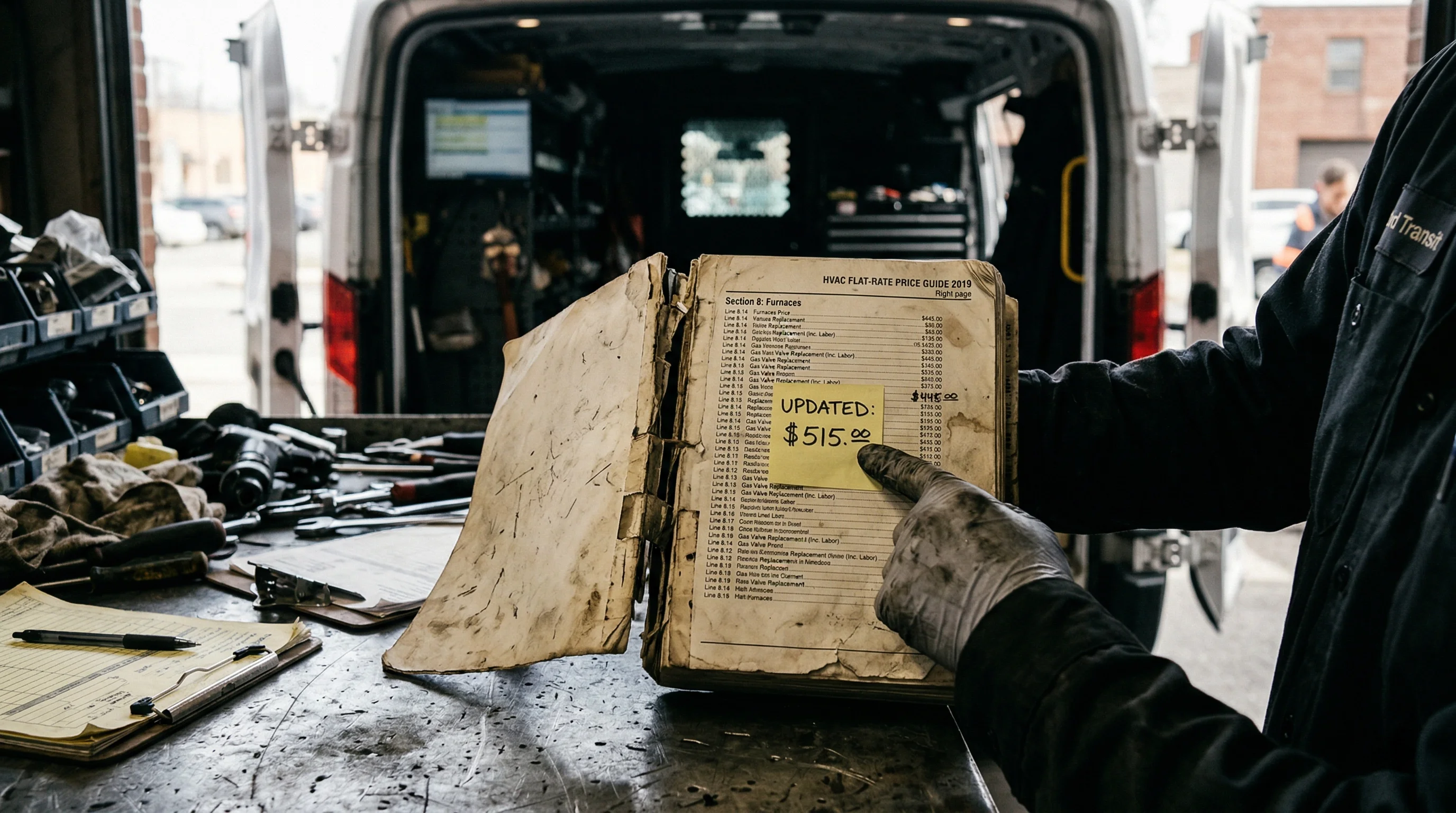
A price book built in January 2024 and never touched is quietly losing you money in 2026.
HVAC equipment prices have increased significantly since 2019. System replacements that ran $6,000 to $8,000 in 2019 now run $12,000 to $15,000. Parts prices have followed similar trajectories. Manufacturer price increases have been regular — Carrier announced 6 to 8% increases, Lennox went up 10%, Trane 2 to 5% in 2025. If your flat-rate prices for parts haven’t been updated to reflect current wholesale costs, your margins are eroding with every job.
The standard for price book maintenance: review and update at minimum twice per year. Quarterly is better for high-parts-cost jobs like compressors and heat exchangers where wholesale costs are more volatile.
Underpriced service calls usually become obvious at the end of the job, when labor time and real field complexity are impossible to ignore.
Build the update process into a standing calendar event. Assign one person — office manager or service manager — to pull current parts cost from your distributor, check that loaded labor rates still reflect actual wages, and flag any job types where your recent margin data shows the price is too low. The update shouldn’t take more than two hours if the book is organized.
The connection to service agreements: service agreement pricing also drifts if it’s not reviewed alongside the repair price book. If your agreement price is $185 and you’ve raised repair prices since it was set, the agreement discount you’re offering has quietly grown. The HVAC service agreements article covers agreement pricing structure in detail — the same discipline applied to the price book applies to agreement pricing.
The CSR Role in Pricing Consistency
Flat-rate pricing doesn’t end with the tech. It starts before the tech arrives.
When a homeowner calls about a repair and asks for a price estimate, the CSR’s answer either supports or undermines your price book. “It could be anywhere from $150 to $800 depending on what’s wrong” is an answer that makes your flat-rate price feel arbitrary when the tech arrives. “Our diagnostic fee is $89, and that gets applied to any repair we do. The tech will let you know the exact cost before starting any work” is an answer that sets accurate expectations and primes the homeowner for a transparent price presentation.
The HVAC CSR performance article covers the booking ask and script discipline. Pricing communication is part of the same system — the CSR sets expectations, the tech confirms the price from the book, and the homeowner approves before work starts. Any gap in that chain creates friction that flat-rate pricing was designed to prevent.
What to Do This Week
- Pull five jobs done by different techs last month. Pick the same repair type — capacitor replacement, contactor, thermostat. What did each tech charge? The spread is your starting measurement of the pricing inconsistency problem.
- Calculate your loaded labor rate. Take your average technician wage. Add payroll taxes (roughly 10%), health insurance contribution, vehicle cost per day, and a share of monthly overhead. Divide the total by billable hours per month. That’s your floor. If your current billing rate is close to it, you’re leaving almost no margin.
- Build prices for your 20 most common repairs. Use average job time from your last 90 days. Apply your loaded labor rate. Add parts at 2.5 to 3x commodity cost. Add your target margin (50 to 65% gross). That’s your flat-rate price for each job.
- Use the marketing cost calculator to see what your current average ticket implies about revenue per truck. If your average ticket is below the benchmark for your market, pricing is likely one of the primary gaps — not call volume or channel mix.
Once your pricing math is clear, see the sample and pricing for the Built on Tenth Market Report if you want to pair it with a clearer picture of what stronger competitors are taking in your city. Or browse all HVAC Market Insights if you want to keep working through the supporting research.
Frequently Asked Questions
What is flat-rate pricing for HVAC?
Flat-rate pricing charges a fixed price per repair task regardless of how long it takes. Instead of billing by the hour, you charge a predetermined amount for each job type — for example, $385 for a capacitor replacement whether it takes 30 minutes or 75 minutes. The price is disclosed to the customer before work starts, covers all parts and labor, and typically includes a warranty on the work performed.
How much more revenue does flat-rate pricing generate?
HVAC companies switching to flat-rate pricing typically see 15 to 20% higher revenue per service call compared to time-and-materials pricing, according to data across multiple studies. The improvement comes from pricing consistency — eliminating the underbidding by junior or less-confident techs who quote below the actual cost of the job. Presenting Good / Better / Best options on applicable jobs can add a further 15 to 25% increase in average ticket.
How do I calculate flat-rate prices for HVAC repairs?
The formula: (average job time x loaded labor rate) + (parts cost x markup multiplier) + overhead allocation + target profit margin. Your loaded labor rate is total technician cost per hour including wages, taxes, benefits, vehicle, and overhead — typically 2.5 to 3.5x the technician’s hourly wage. Parts markup is 2.5x to 3.0x for commodity parts, lower for high-cost components. Most residential HVAC companies target 55 to 65% gross margin on repairs.
What are the most common HVAC flat-rate pricing mistakes?
The four most common: using best-case job time instead of average time (prices too low, jobs exceed the estimate regularly), failing to update the price book when parts and labor costs rise (margins erode silently), allowing techs to negotiate prices down in the field (undermines the book’s credibility), and not covering enough job types (techs revert to memory pricing for jobs not in the book). Start with your 30 most common repairs and build from there rather than trying to price everything upfront.
How often should I update my HVAC price book?
At minimum twice per year. Quarterly is better for jobs with high-cost components like compressors, coils, and heat exchangers where parts pricing is more volatile. Manufacturer equipment prices have increased 6 to 10% annually in recent years. If your price book doesn’t track those increases, your margins are shrinking on every parts-heavy job. Assign one person to own the quarterly update — it should take two hours once the book is organized.
Does flat-rate pricing hurt close rates?
Done right, it improves close rates. Customers approve quoted work more readily when the price is disclosed upfront and includes a warranty, compared to hourly billing where the final amount is uncertain. The “no surprise” framing — you know the price before we start — removes the anxiety that causes customers to hesitate. Some customers will push back on flat-rate prices that seem higher than their expectation; the response is to explain what the price includes: parts, labor, warranty, and a guaranteed final cost.
What software do HVAC companies use for flat-rate pricing?
ServiceTitan, Housecall Pro, FieldEdge, and Jobber all include price book functionality that allows techs to access and present flat-rate prices from a mobile app in the field. The mobile access is critical — a price book on a printed sheet or a PDF the tech has to look up separately gets ignored. When the price lookup is two taps from the job screen, compliance goes up significantly. Most of these platforms also allow automatic price updates across all tech devices when the book is revised centrally.
How does flat-rate pricing connect to revenue per truck?
Average ticket is one of the five variables that determine revenue per truck. A technician running the same number of jobs per day at a higher average ticket generates proportionally more revenue without working harder or longer. Pricing inconsistency — techs quoting the same jobs at different prices — is one of the primary causes of average ticket gaps between technicians. A price book collapses that spread by standardizing what each job costs. Companies that implement flat-rate pricing consistently typically see the spread between their highest and lowest average-ticket technicians narrow within 60 to 90 days.