When a homeowner searches for HVAC repair in your city, the first thing they see is not a list of websites. It is a map with three business listings. That map pack captures roughly 42% of all clicks on a local HVAC search. The three businesses inside it take most of that traffic. The businesses below it get very little.
If your company is not in the top 3, you are not really competing for organic traffic in your market.
This article is not about auditing your own Google Business Profile from scratch. If you want that, the GBP audit piece covers the framework in detail. This piece is about something different: what the companies holding positions 1 through 3 in real, competitive HVAC markets actually look like. What they have built. What separates them from position 4, 5, and below.
Why Map Pack Position Matters More Than You Think
Position 1 in the map pack does not just get more traffic than position 4. In most markets, it gets a completely different category of traffic.
Studies on local search behavior consistently show that the first map pack listing captures 44% of all map pack clicks. The second gets around 31%. The third gets roughly 17%. Position 4, which sits below the visible map pack in most searches, captures a fraction of what position 3 gets.
Translate that into calls. If a top-3 position in your market generates 90 inbound calls per month and your average booking rate is 45%, that is 40 booked jobs. A business at position 5 in the same market might see 12 calls. Same city, same search volume, completely different phone activity.
The math behind your Phone Revenue Calculator becomes much easier to understand when you see where the calls are actually going.
What Top-Ranked HVAC Companies Usually Have in Common
After looking at HVAC map pack leaders across markets in the $1M to $10M revenue range, a few patterns come up consistently. None of them are secrets. Most owners know what they are. The gap is usually in execution volume and consistency.
Review Count and Velocity
In competitive markets, top map pack positions typically require 150 to 400+ Google reviews. The industry average for HVAC companies is 17 reviews. Roughly 18% of HVAC businesses have zero.
Review count alone is not the full picture. Velocity matters as much as raw numbers. A company with 400 reviews but nothing in the last three months looks stale to Google’s algorithm. A company with 80 reviews getting 15 to 20 new ones per month is often outranking the larger but dormant competitor.
Google weights recency heavily. Consistent, ongoing review generation is not just a nice-to-have, it is one of the most reliable ranking signals you can control.
A realistic pace for a company moving from 30 reviews toward 200 is 15 to 20 new reviews per month. At that pace, you reach 200 reviews in roughly 9 to 11 months. That is the minimum competitive floor in most mid-size markets. In major metros like Phoenix, Dallas, or Atlanta, the top 3 often have 500 or more reviews.
The HVAC Google Reviews benchmark piece goes deeper on velocity targets and how to close a review gap realistically.
Rating Quality
A 4.5-star average or better is the threshold that matters. Below 4.0 stars, click-through rates drop significantly. Many customers filter out low-rated businesses before they even look at the profile details.
If your rating is below 4.5, the fastest mathematical fix is volume. Twenty five-star reviews will pull a 3.9 average up faster than trying to get individual bad reviews removed. You cannot outargue a bad review pattern. You can outvolume it.
Category Setup
Most HVAC companies choose one primary category and leave the rest empty. That mistake alone limits which searches trigger your listing.
The primary category for most HVAC companies should be “HVAC Contractor.” That gives the broadest ranking eligibility. Secondary categories should be added to cover what you actually want to rank for: “Air Conditioning Repair Service,” “Heating Contractor,” “Furnace Repair Service,” “Air Conditioning Contractor.”
Some HVAC companies with established profiles adjust their primary category seasonally, switching to “Air Conditioning Contractor” in summer and “Heating Contractor” in winter. This is an advanced tactic and can temporarily disrupt rankings during the transition. It works best for companies already in the top 3 looking to hold position during peak season, not for companies trying to break into the top 3 for the first time.
Each category you add unlocks new ranking eligibility for related search queries. If you are only running one category, you are limiting the searches your profile is eligible to appear in before your competitors even have to compete with you.
Photo and Posting Activity
Google rewards profiles that look active. Profiles with photos get more clicks. Recent posts signal to Google that the business is operating and engaged.
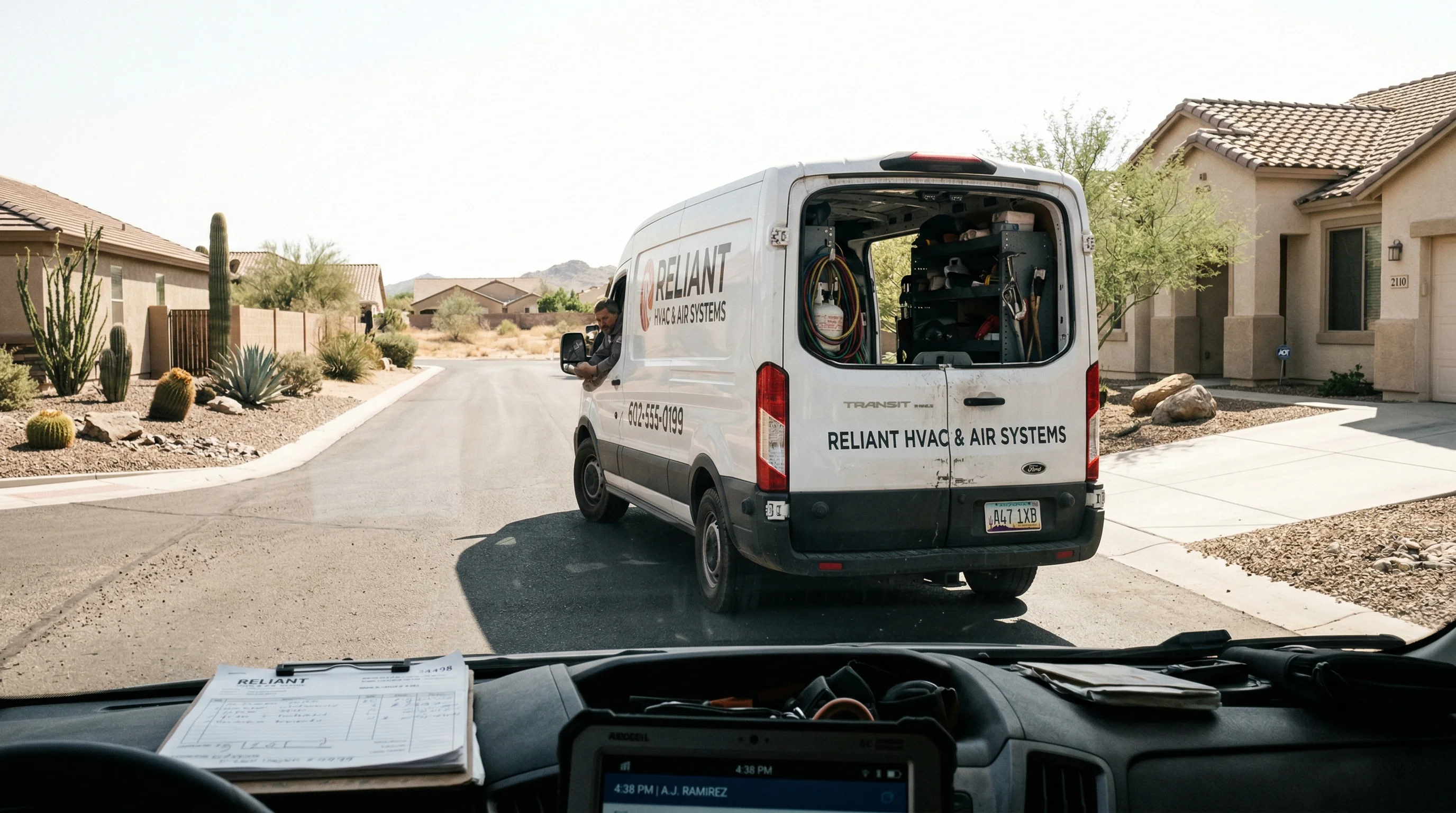
Top-ranked HVAC companies in competitive markets are typically uploading new photos monthly. The photos that perform best are operational: trucks in the field, techs on a job, before-and-after equipment shots, team photos. Not stock images.
Google Posts function like micro-updates on your profile. They show up in search results and keep the profile active. Top-ranked operators are posting at least two to three times per month. This is a low-effort signal that most HVAC companies skip entirely.
Website Alignment
Your GBP and your website are not independent systems. Google scans your connected website for signals that confirm what your GBP claims.
Top-ranked companies have websites that reinforce their GBP categories and service area. If your GBP says you serve eight cities but your website has only a generic homepage with no service-area content, Google has less confirmation of your geographic reach.
Service pages for each major category (AC repair, furnace repair, installation, duct cleaning, heat pumps) and location pages for the cities you actually serve are two of the most reliable ways to strengthen map pack rankings through your website. They give Google something to scan that matches what your profile is claiming.
The Revenue Cost of Being Position 4
Position 4 is not a mild disadvantage. It is a structural exclusion from the majority of high-intent traffic in your market.
Work through the numbers for your own situation. Start with how many calls you receive per month from organic sources. Now estimate how many more calls the top-3 company in your market is getting. The Whitespark 2026 Local Search Ranking survey confirms that GBP signals, specifically categories, review count, and review velocity, remain top-tier ranking drivers. Companies that lead in those signals consistently outperform companies that do not, regardless of how many years they have been operating.
The gap between position 1 and position 4 in a mid-size market is often 50 to 80 calls per month. At a $350 average ticket and 45% booking rate, that is $7,875 to $12,600 in monthly booked revenue you are not capturing. That is before accounting for service agreement upsells and repeat customer lifetime value.
Your Built on Tenth Market Report maps your specific ranking position across your service area and shows you where competitors are outranking you, what visible trust gaps exist, and what the gap is likely costing in missed calls. It is not a generic audit. It is built from your actual market.
What Separates Position 3 from Position 1
Most HVAC owners assume position 1 companies have some technical advantage that is hard to replicate. Usually they do not.
The companies holding position 1 in most markets are doing the same things as position 3 companies, but with more volume and more consistency. More reviews per month. More photos. More frequent posts. Slightly better category setup. A website that more clearly confirms the geographic service area.
The gap is almost always execution volume, not secret strategy.
The GBP audit framework gives you a complete checklist for what to inspect in your own profile. Use that piece to identify what is missing. Use this piece to understand what you are benchmarking against.
Using the GBP Scorecard to Find Your Gap
The GBP Scorecard gives you a fast self-diagnostic on where your profile stands across the signals that actually move map pack rankings. It covers categories, review count, review velocity, photo count, posting activity, and website alignment.
Run it against your own profile, then spend 20 minutes looking at the top 3 in your market. Pull their review counts. Look at when their last review came in. Check their photo count. See what categories they have listed.
The gap you find there is the gap that is costing you calls every month.
What to Do If You Are Not in the Top 3
The path into the top 3 is not complicated, but it takes time and consistency.
Start with category setup. That is a same-day fix that costs nothing. Add the right primary category and fill in your secondary categories based on what you actually do.
Then build a review generation system. Not a one-time push. A repeatable process where techs ask for reviews after every completed job, with a follow-up text or email. A rate of 15 to 20 new reviews per month is achievable for most HVAC companies doing 20 or more jobs per month.
Then address your website’s geographic confirmation. If you serve eight cities, make sure your website reflects that with real content, not just a list of city names in a footer.
None of this is fast. Map pack rankings move on a timeline of months, not weeks. But the compounding effect of consistent execution is real. Companies that commit to this for six months typically see meaningful ranking movement in most competitive markets.
If you want to understand where your company actually sits in your market relative to the companies above you, and what those gaps are likely costing in booked revenue, that is exactly what the Built on Tenth Market Report is built to show you.
Frequently Asked Questions
How long does it take to rank in the HVAC map pack?
Category and profile changes can show early movement in two to four weeks. Review-driven improvements take two to three months of consistent generation. Full map pack impact from a comprehensive effort typically shows within three to six months, depending on how competitive your specific market is.
What is the most important factor in HVAC map pack ranking?
The Whitespark 2026 Local Search Ranking survey puts GBP signals at the top, specifically category accuracy, keyword relevance, and profile completeness. Review signals, including count, velocity, and rating quality, are the second-highest category. On-page website signals and local link signals follow.
Can I rank in cities where I do not have a physical address?
Google Maps heavily prioritizes businesses with a physical location close to the searcher. You can set a service area and hide your address if you operate out of a home or shop, but ranking in cities far from your actual location is significantly harder. Service area pages on your website that specifically mention those cities help, but they do not fully offset the proximity signal.
Does responding to Google reviews help rankings?
Review response is a conversion signal more than a direct ranking signal. Businesses that respond to reviews consistently see better click-through rates because potential customers see an active owner. Google also rewards profiles that show engagement. It is worth doing for both reasons.
How many reviews do I need to compete in a major metro?
In highly competitive metro markets like Atlanta, Dallas, or Phoenix, the top 3 HVAC companies often have 300 to 500+ reviews. A realistic entry floor for a major metro map pack is 150 to 200 reviews with consistent monthly velocity. In smaller cities and suburban markets, 75 to 150 reviews is often enough to compete for top positions.