AUDITOR’S OVERVIEW
The “follow-up gap” is the most common reason HVAC companies fail to hit their system replacement targets. For most operators, follow-up is an informal activity—a technician might send a text a few days later, or a comfort consultant might make a single phone call. This lack of structure directly impacts your close rate on high-ticket jobs where the homeowner is comparing multiple quotes and facing a complex financial decision.
THE BOTTOM LINE
System replacement follow-up is a timing problem, not a persistence problem. Our analysis of top-performing sales operations shows that 65% of follow-up conversions happen within the first 48 hours of the estimate. If your follow-up sequence doesn’t start within 24 hours of the diagnostic visit, you aren’t just losing jobs—you are essentially funding your competitors’ sales efforts by doing the initial diagnostic for them.
This research dossier breaks down the annual dollar cost of the follow-up gap at real HVAC estimate volumes and provides the exact four-touch cadence that recovers unsold jobs.
What the Numbers Say About Why HVAC Estimates Go Cold
The default assumption when an HVAC estimate goes cold is that the homeowner decided no. The data consistently shows something different.
Research on service business follow-up behavior shows that more than 80% of sales require five or more follow-up attempts. The average service business makes fewer than two. In HVAC specifically, where the homeowner may be making a $5,000 to $12,000 replacement decision for the first time, the inertia on both sides is real.
The Blue Collar Success Group’s 2025 benchmarks found that nearly half of high-revenue HVAC contractors, those above $10M, reported follow-up on unsold estimates accounting for 11 to 15% of their total income. That is not a marketing number. It is a pipeline management number. Revenue that was already partially earned through the estimate itself, then recovered through the discipline of following up on it.
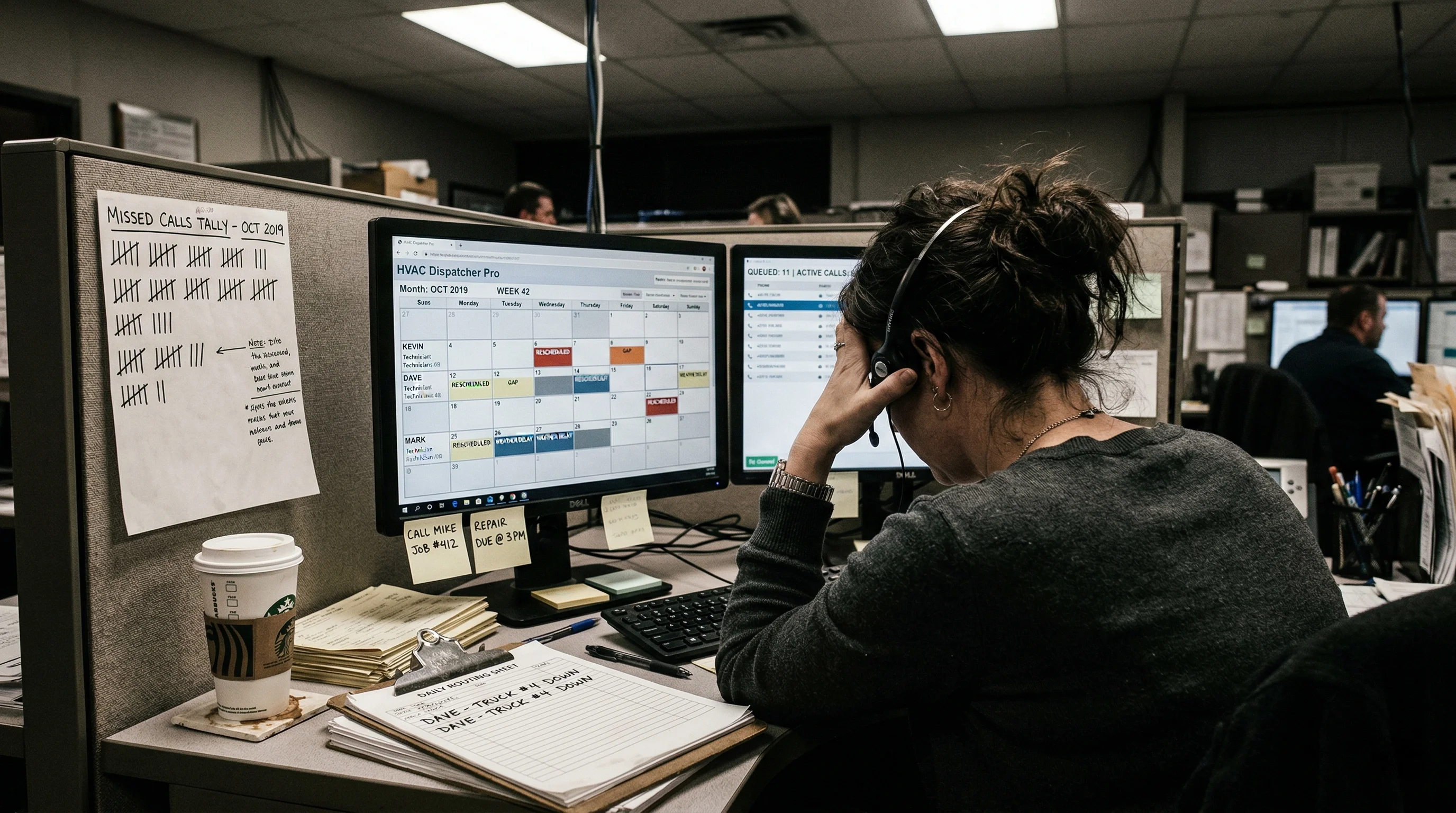
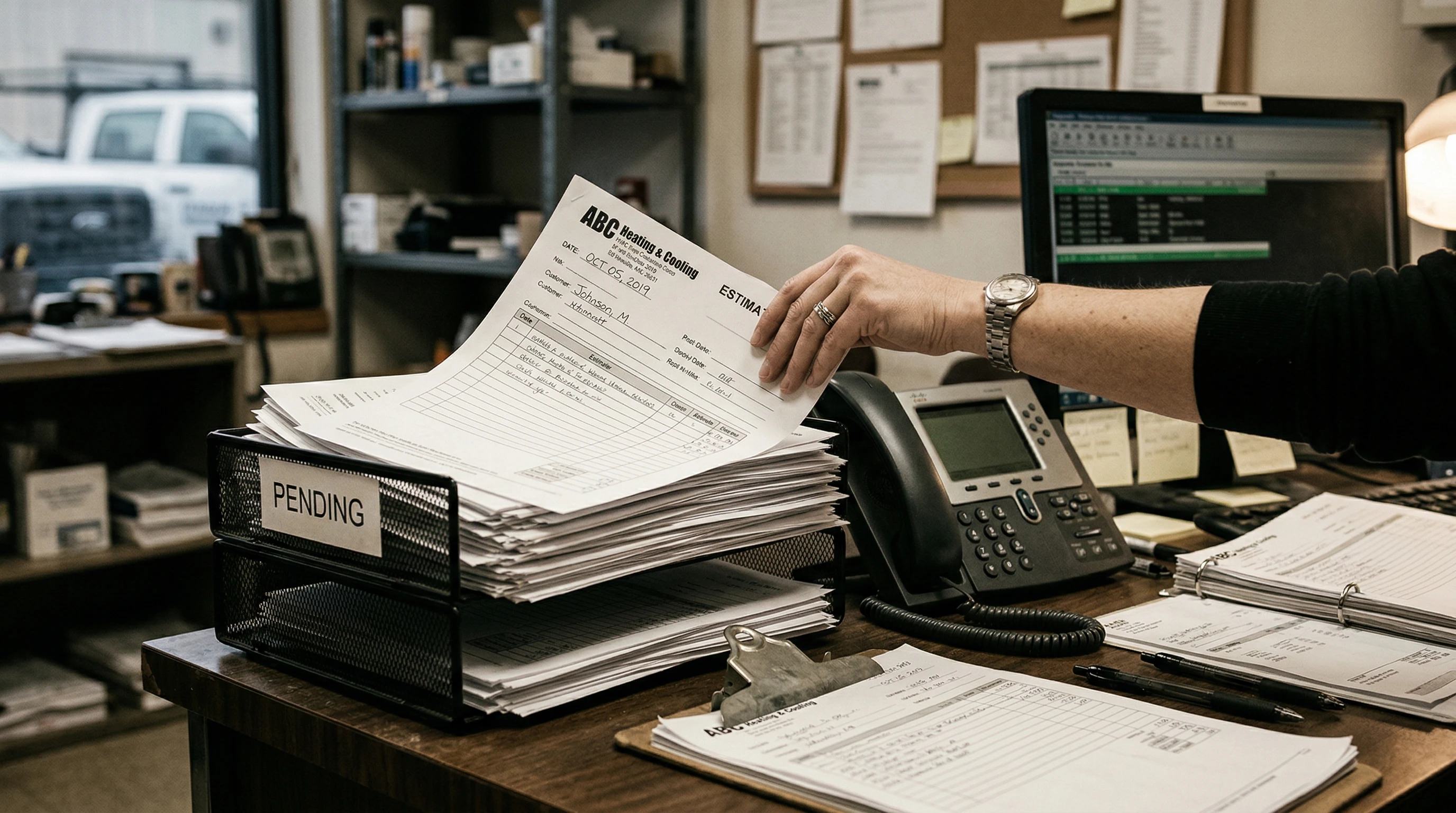
The reason the gap persists is not that HVAC owners do not believe follow-up matters. Nobody owns it. The tech who ran the call sent the estimate and moved to the next job. The CSR who booked the original call is not tracking the estimate outcome. The owner is watching total revenue but not estimate-to-close rate. Nobody is watching the outbox.
The Dollar Math at Real HVAC Volumes
These are the numbers that come out of the Estimate Follow-Up Calculator at typical HVAC operating scales.
A $1.5M HVAC company running replacement and service estimates:
- Estimates sent per month: 80
- Current close rate: 38%
- Jobs booked per month: 30
- Estimates going cold each month: 50
At 50 cold estimates per month and a $3,200 average replacement ticket, if structured follow-up recovers 20% of those cold estimates, that is 10 additional booked jobs per month. At $3,200 each: $32,000 per month in recovered revenue, $384,000 per year. From the same call volume, the same marketing spend, and the same technicians.
A $2.5M HVAC company running primarily replacement work:
- Estimates sent per month: 65
- Current close rate: 27% (replacement-heavy)
- Jobs booked per month: 18
- Estimates going cold each month: 47
At 47 cold estimates and a $9,500 average replacement ticket, recovering 15% of cold estimates is 7 additional jobs. At $9,500 per job: $66,500 per month, $798,000 annually.
These numbers explain why the estimate follow-up gap sits alongside missed calls as the two largest recoverable leaks in HVAC pipeline management. The Phone Revenue Calculator shows what missed calls cost. The Estimate Follow-Up Calculator shows what cold estimates cost. Most owners who run both for the first time find the combined number is larger than their entire annual marketing budget.
Follow-Up vs Buying More Leads
The math on follow-up versus paid lead generation is worth making explicit, because most HVAC owners instinctively reach for more leads when revenue is flat rather than examining the estimate pipeline.
Say your HVAC company sends 50 replacement estimates per month at a $9,500 average ticket and closes 27% of them. You are booking 13 to 14 jobs. You want 18 per month.
Option 1: Buy more leads. To book 4 to 5 more jobs per month at 27% close rate, you need 15 to 19 more qualified estimates. At $80 per LSA lead and a 55% contact rate, you need roughly 27 to 35 additional leads per month. At $80 each, that is $2,160 to $2,800 in additional monthly spend.
Option 2: Follow up on existing cold estimates. You are already generating 50 estimates per month and closing 27%. The 36 to 37 that go cold contain the same jobs you are trying to buy. Recovering 15% of those cold estimates is 5 to 6 additional booked jobs per month at zero incremental lead cost.
The follow-up path generates more jobs from the same call volume. The math is not close.
PIPELINE SYSTEMS
Are You Leaving $15,000 in Monthly Replacements to Inertia?
Calculate the exact revenue impact of a 4-touch follow-up sequence on your current open-estimate volume.
AUDIT YOUR FOLLOW-UP ROI →The Channel and Timing Benchmarks
Not all follow-up is equally effective. The timing of the first touch and the channel used both affect response rate significantly.
Timing: The first follow-up should happen within 24 hours of sending the estimate, not three days later. Research on home service lead response consistently shows that response time is one of the strongest predictors of eventual conversion. An estimate followed up on day 1 converts at meaningfully higher rates than the same estimate followed up on day 4.
Channel: Text outperforms email as a first follow-up touch for most HVAC estimate types. A homeowner who has already met your tech and received a written estimate is receptive to a brief, direct text confirming receipt and offering to answer questions. Email open rates in home services are low enough that relying on email for the first touch delays the conversation.
Phone calls produce the best direct booking rate on the second touch, after the text has confirmed the estimate was received. The combination of text first, phone call second, then email or text for the third touch produces consistently higher response rates than any single-channel approach.
Channel comparison by touch:
| Touch | Channel | Best timing | Purpose |
|---|---|---|---|
| Touch 1 | Text | Day 1 after estimate | Confirm receipt, open channel |
| Touch 2 | Phone call | Day 3 | Answer questions, create soft scheduling urgency |
| Touch 3 | Text or email | Day 7 to 10 | Introduce financing, final close attempt |
| Touch 4 | Text | Day 30 | Reactivation of dormant estimate |
Why “I Already Called Them” Is Not a Follow-Up System
The most common version of HVAC estimate follow-up: a tech or office staff member calls the homeowner once, gets no answer or “we are still thinking about it,” and logs the estimate as pending. Two weeks later it is written off.
That is one touch. Not a system.
What makes the difference between recovering 5% and 25% of cold HVAC estimates is not effort. It is structure. Specifically three things: timing of the first touch, number of touches in the sequence, and who owns the outbox daily.
The three-touch sequence that produces the best documented results for HVAC replacement work:
Touch 1, Day 1, text: Confirm receipt, offer to answer questions, no pressure. A homeowner who did not receive the estimate does not know to ask about it. This touch confirms the pipeline and opens a direct channel.
Touch 2, Day 3, phone call: Reference the estimate specifically. Mention that you have availability this or next week. The scheduling mention creates soft urgency without pressure.
Touch 3, Day 7 to 10, text or email: Introduce financing as an option if the ticket is above $5,000. This touch recovers a specific subset of cold HVAC estimates: homeowners who want the work done but hesitated on the total price. The connection between financing availability and HVAC replacement close rate is significant. The Close Rate Benchmarks article covers how financing moves replacement win rates by 6 to 15 percentage points.
After three touches with no response, the estimate goes to a 30-day dormant file. A single reactivation text at 30 days recovers a meaningful percentage, particularly on HVAC replacement estimates where the homeowner’s equipment situation has continued to deteriorate.
The Difference Between a Follow-Up Problem and a Close-Rate Problem
Not every cold HVAC estimate is a follow-up failure. Some cold estimates reflect a genuine close rate problem: the homeowner received the estimate, compared it to competitors, and chose a lower price.
The diagnostic question is: are your estimates going cold before the first follow-up touch, or after it?
If most of your cold estimates have received at least one follow-up and still did not close, you have a close rate and competitive positioning issue, not a follow-up issue. The relevant questions shift to: are you presenting financing? Are you offering multiple system options? Are you competitive on price in your specific market, or are lower-priced competitors consistently winning on replacement quotes?
If most of your cold estimates have received zero follow-up, the follow-up system is the fix. Build that first before drawing conclusions about close rate.
For the close-rate side of this picture, the HVAC Close Rate Benchmarks article covers what healthy ranges look like by replacement context and what the primary levers are.
What to Do This Week
-
Pull your estimate history for the last 60 days. Count estimates sent, jobs booked, and estimates that received at least one follow-up contact. That third number is your baseline.
-
Run the Estimate Follow-Up Calculator. Enter your estimate volume, average ticket, and current close rate. The tool calculates your annual revenue gap and shows what 50% and 80% follow-up rates would recover.
-
Assign the outbox. Decide today which person in your operation owns the estimate pipeline. Give them a daily check: any estimate sent more than 48 hours ago with no follow-up logged gets a Touch 1 text today.
-
Write your three templates. Adapt the language above to your company voice. Store them as phone templates or CRM snippets. The first touch should not require drafting from scratch each time.
-
Track estimate close rate monthly. Estimates sent versus jobs booked, by month. This is the leading indicator that shows whether the system is working before the revenue shows up in the year-end numbers.
Frequently Asked Questions
How many times should I follow up on an unsold HVAC estimate?
Three times over seven to ten days, then a single reactivation touch at 30 days. Text on day 1, phone call on day 3, text or email on day 7 to 10 introducing financing if relevant. Most recoveries happen within the three-touch window. The 30-day touch recovers a smaller but measurable percentage of estimates where the homeowner’s situation has changed.
What percentage of cold HVAC estimates can I realistically recover?
Based on documented contractor results, a structured three-touch system recovers 15 to 30% of estimates that did not close on first contact. The lower end reflects higher-ticket replacement work where the homeowner needs more decision time. The upper end reflects service estimates where the problem is acute. At any recovery rate, the revenue recovered exceeds what additional marketing spend on the same call volume would produce.
Who should own the estimate follow-up process?
One specific person, not “whoever has time.” The most practical assignment for companies under $3M is a CSR or office manager with a defined daily check: any estimate sent more than 48 hours ago with no logged follow-up gets a Touch 1 today. Above $3M, a dedicated pipeline coordinator handles this as a primary responsibility.
What is the difference between a follow-up problem and a close-rate problem?
A follow-up problem is when estimates go cold before any outreach happens. A close-rate problem is when estimates receive follow-up and still do not close. If most of your cold estimates have zero follow-up logged, build the system first. If they are being followed up and still not closing, the issue shifts to pricing, financing, options presentation, or competitive positioning in your market.
Does following up aggressively annoy homeowners?
Three touches over seven to ten days is not aggressive. The homeowner who finds that excessive was not going to book regardless. The far more common scenario is a homeowner waiting for you to follow up, who interpreted silence as disinterest and chose someone who did reach back. The risk of following up too much is real but substantially smaller than the risk of not following up at all.
Built on Tenth is an independent HVAC market intelligence firm providing objective, data-backed diagnostic reporting for HVAC operators. We do not sell advertising, accept referral fees, or offer marketing agency retainers. Our loyalty is strictly to the data.