Most HVAC companies that sell a replacement estimate and do not hear back assume the customer went with a competitor.
In most cases, that is not what happened. The homeowner thought about it, did not hear back, and stopped thinking about it.
Inertia kills more replacement estimates than price. This piece covers replacement estimate win rate benchmarks, what actually moves the number, and how to diagnose whether your situation is a follow-up problem, a financing problem, an options problem, or a market positioning problem.
It is intentionally narrower than the broader HVAC estimate follow-up gap article. That piece is about the revenue sitting in unsold estimates across the pipeline. This one is specifically about HVAC replacement quotes and the win-rate drivers unique to higher-ticket system sales.
What Replacement Win Rate Actually Looks Like in Practice
Replacement estimates are a distinct sales category from service call repairs. The dynamics are different enough that treating them with the same close rate expectation is a diagnostic error.
A repair close rate of 85% and a replacement win rate of 33% can coexist at the same company. Both can be normal. The repair close rate reflects a high-urgency, relatively low-dollar decision. The replacement win rate reflects a discretionary, multi-thousand-dollar capital decision that most homeowners have not been planning for.
Normal operating ranges for HVAC replacement estimate win rates:
Below 25%: A problem is present. Something in your follow-up, financing, or trust position is likely contributing to unnecessary losses.
25% to 40%: This is where most HVAC companies operate. The gap between 30% and 40% represents significant revenue potential because of the dollar value of each replacement job.
40% to 55%: Well-run operations with consistent financing offers, structured follow-up, and a strong trust profile in their market.
Above 60%: Worth examining your pricing. Closing nearly every replacement estimate suggests you may be the lowest-priced option in the market, which is not always a position worth holding.
The close rate benchmarks article covers why different call types should never be mixed into a single blended close rate. If you have not been separating your replacement win rate from your overall close rate, start there.
The Four Things That Move Replacement Win Rate
Data from ACCA, contractor surveys, and field service platform research consistently point to the same set of variables. Not all of them are equally weighted, but all four are worth addressing.
1. Financing Availability and Introduction Timing
This is the highest-impact single variable for most HVAC companies. ACCA survey data shows that contractors who never offer financing see 50% of their replacement sales at the base-model entry level. Contractors who consistently offer financing see that percentage drop to 35%, with more sales at mid-tier and premium system levels.
Beyond system tier, financing directly affects close rate. Survey data from contractors across the country shows close rates moving from 77% to 83% when financing is introduced consistently and early in the conversation. That 6-point lift is not small. On 20 replacement estimates per month at $9,500 average ticket, 6 more percentage points in win rate is $11,400 in additional monthly revenue.
The timing of the financing offer matters as much as the offer itself. Introducing financing after the homeowner has already balked at the price is a harder conversation than introducing it as part of the initial options presentation. The framing shift is from “this is what it costs, but you can finance it” to “here is what you get and here is the monthly investment.”
2. Options Presentation Structure
Replacement estimates presented as a single system at a single price give homeowners a binary decision: buy or do not buy. Estimates presented as three options at different price points, each with clear benefit differences, shift homeowners into a choice state instead of a buy-or-reject state.
The difference in close rate between single-option and multi-option replacement presentations is real. Contractors who present at minimum two options, and ideally three, consistently report higher close rates and higher average tickets than those presenting a single recommendation.
One HVAC owner in Florida described his approach as fully a la carte: explaining the value differences between systems clearly and letting homeowners build toward what fits their priorities. “We really like to sell our bill of goods that our technicians are top-flight technicians,” he noted, emphasizing that the goal is to sell what the customer wants, not to sell down to price. His close rates on replacement estimates consistently run above 45%.
3. Speed to Follow-Up
Research across home service industries shows that responding to a lead within five minutes of initial contact increases conversion by up to 400% compared to waiting an hour or longer. The same time-sensitivity applies to open replacement estimates.
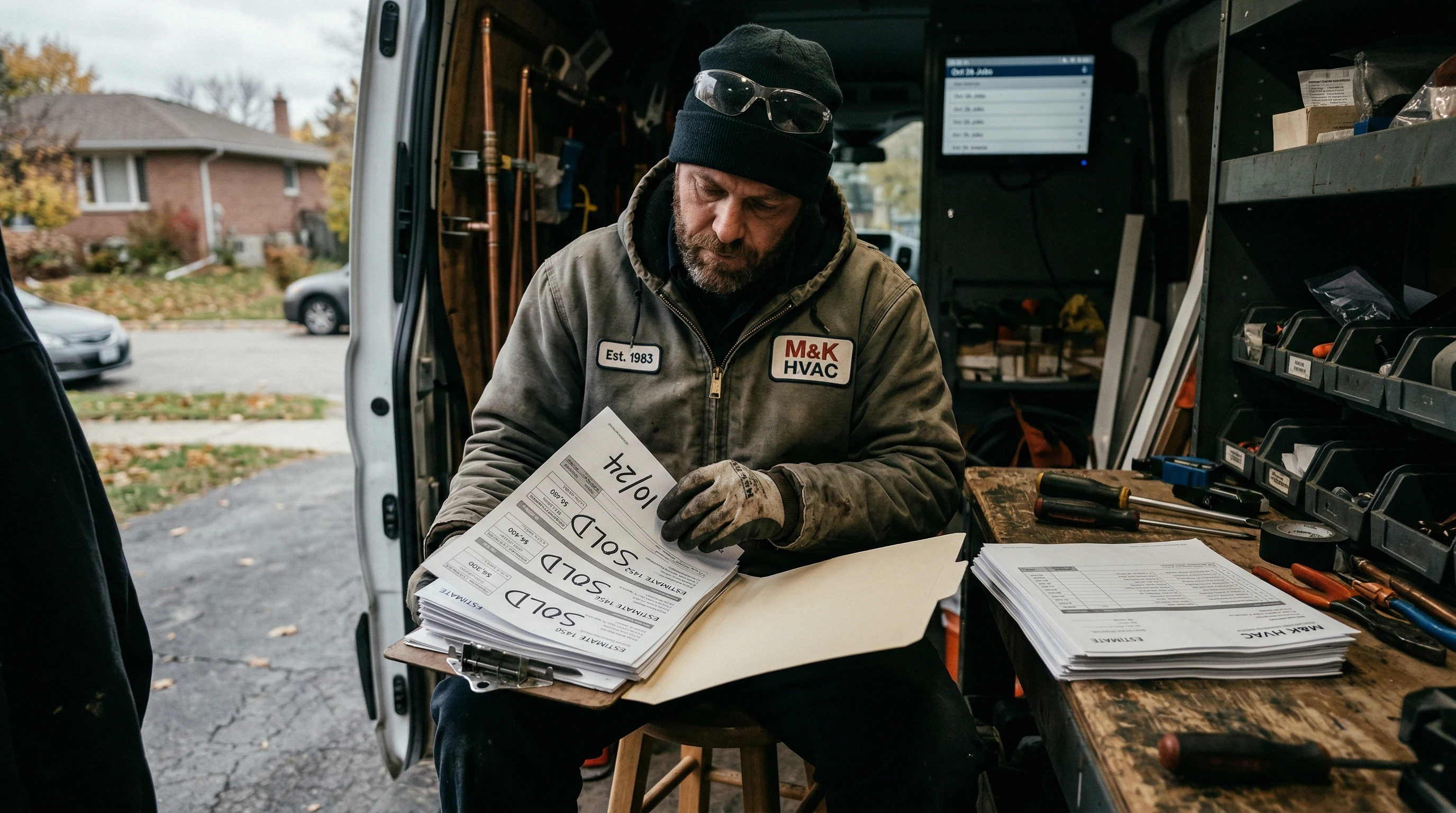
Most replacement estimates that go unfollowed for more than 48 hours are not lost to a competitor. They are lost to inertia. The homeowner’s urgency fades. Other priorities appear. The system that was failing continues limping along, and the replacement decision gets deferred.
A two-call follow-up structure covers most of the recoverable ground. A first contact at 24 hours, either a text or a call, with a specific reference to the estimate and a question about any remaining questions. A second contact at 48 to 72 hours if no response. After that, a scheduled follow-up at 30 days.
Data from Hatch’s analysis of 163,000 estimate follow-up campaigns shows that multi-touch, multi-channel follow-up campaigns significantly outperform single-touch follow-ups. The channel mix that works best in most HVAC markets is a combination of text and phone call, not email alone.
The Estimate Follow-Up Calculator shows you the dollar value of a specific improvement in your follow-up rate based on your current estimate volume and average replacement ticket.
4. Trust Signals Before the Tech Arrives
Replacement estimates are not sold purely in the room during the presentation. They are influenced by what the homeowner looked up before the tech knocked on the door.
A homeowner who searched for HVAC companies in their area, found two or three options, and saw that your company has 240 reviews averaging 4.7 stars versus a competitor with 28 reviews averaging 4.2 stars is walking into your estimate conversation differently than if the review situation were reversed.
The trust that your online presence builds before a tech arrives affects the homeowner’s receptivity during the estimate conversation. It affects how seriously they take the recommendation. It affects whether they call a second company for a competing quote before making a decision.
This is the connection point between map pack visibility and replacement sales economics. A company that ranks at position 1 in the map pack with strong reviews is walking into replacement conversations with a trust advantage that compounds into close rate over time.
The Follow-Up That Recovers the Most Revenue
Beyond the immediate 24-to-48-hour follow-up, there is a second category of replacement revenue that most companies leave entirely untouched: old estimates.
One HVAC contractor described re-engaging estimates that were 12 months old through an automated follow-up campaign. The result was several hundred thousand dollars in closed replacement revenue from customers who had deferred the decision and simply needed a nudge a year later.
This is not a universal result, but the general principle holds. An open replacement estimate from six to twelve months ago, on a system that is now one year older and one year closer to failure, is a customer who may be considerably more receptive than they were when the estimate was first presented. A brief, respectful follow-up with updated pricing and an easy path to re-engage costs almost nothing and recovers a meaningful percentage of those conversations.
If you have a backlog of open replacement estimates older than 60 days, that backlog represents a real revenue number. The Estimate Follow-Up Calculator can help you size it.
When Low Win Rate Is a Market Problem, Not a Sales Problem
Not every replacement win rate issue is internal. Some HVAC markets have aggressive low-price competitors who consistently undercut replacement quotes by $1,500 to $3,000 and win a large share of the price-sensitive segment.
If you are losing replacement estimates consistently to competitors at significantly lower prices, and your internal follow-up and financing offer are well-executed, the problem may be partly structural. The homeowners who are shopping on price and getting multiple quotes will gravitate toward the lower option unless they have a strong trust reason not to.
Understanding who the low-price competitors in your market are, what their online presence looks like, and where they are ranking is part of the diagnosis. The Built on Tenth Market Report surfaces that competitive picture for your specific market.
The strategic response is not to match their price. It is to build a trust profile strong enough that price-sensitive homeowners who find you first are less likely to keep shopping. Review count, response quality, and a professional consultation process are the levers for that.
Frequently Asked Questions
What is a normal HVAC replacement estimate win rate?
The industry operating range is 30% to 40% for most companies. Top performers with strong financing offers, structured follow-up, and good trust signals in their market close 45% to 55% of replacement estimates. Below 25% is a signal that something specific needs attention.
How much does financing improve HVAC replacement close rates?
ACCA data and contractor surveys consistently show 6 to 15 percentage point improvements in close rate when financing is offered consistently and early. The lift is most pronounced in markets where the average replacement ticket is above $8,000 and where homeowners are not planning for the expense.
How long should I follow up on an open replacement estimate?
Follow up at 24 hours with a text or call, again at 48 to 72 hours if no response, and again at 30 days. Old estimates that are 6 to 12 months open are worth a single re-engagement outreach. Many homeowners who deferred the decision become more receptive as the system ages further.
Should I present multiple options on every replacement estimate?
Yes. Presenting at minimum two options, and ideally three at different price points, shifts the homeowner from a buy-or-reject decision to a choice between options. This consistently produces higher close rates and higher average tickets than single-option presentations.
When is a low win rate a market problem rather than a sales problem?
When your internal follow-up, financing, and options presentation are well-executed, but you are still losing estimates consistently to significantly lower-priced competitors, you may have a local competitive positioning issue. The answer is building trust signals strong enough that homeowners are less likely to shop after finding you, not matching competitor pricing.