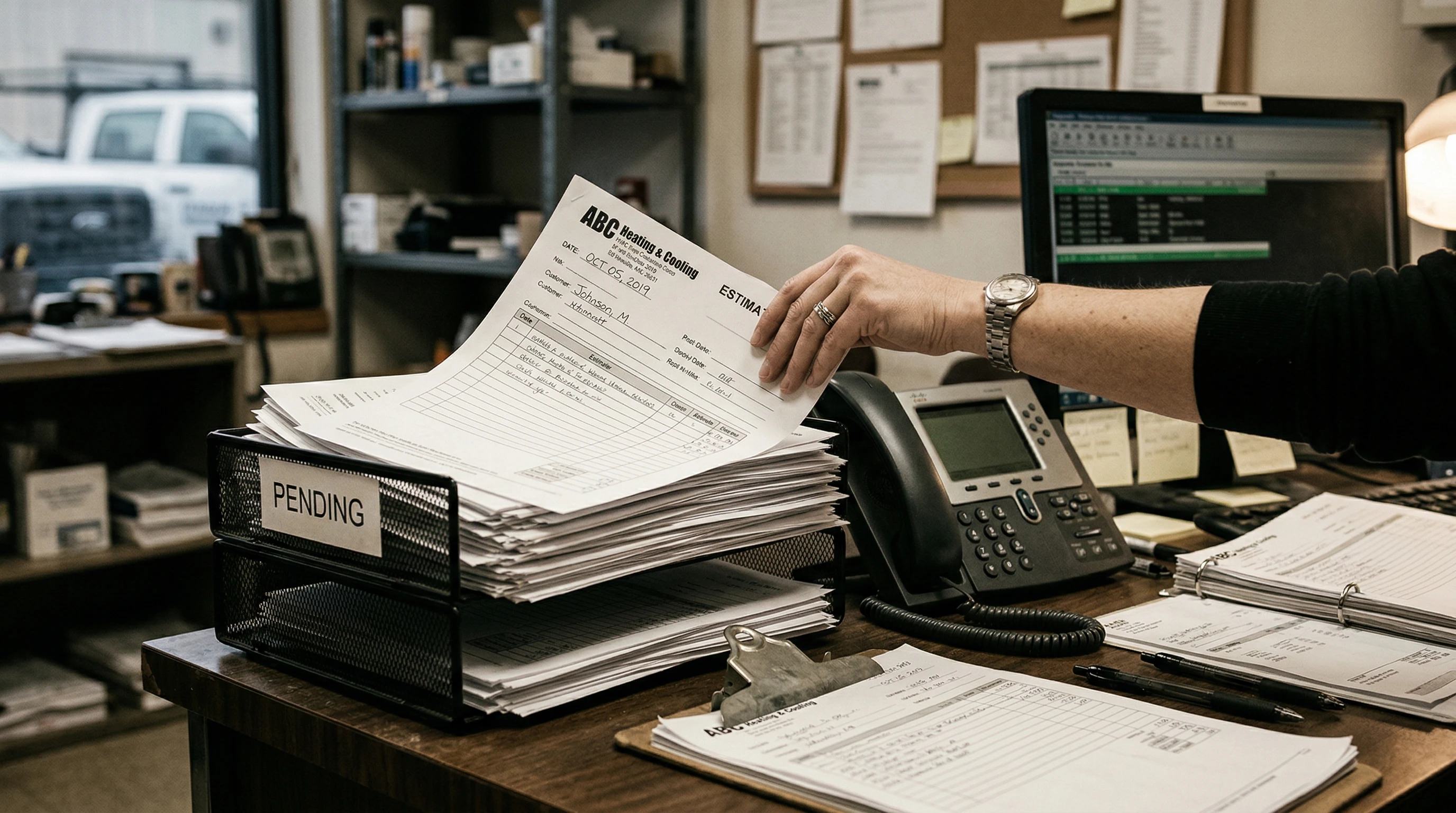
In January, we audited a $2.1M HVAC company in the Southeast.
They were sending around 90 estimates per month. Replacing systems, repairing units, maintenance agreements. Good techs. Fair prices. Solid Google reviews.
Their close rate on sent estimates: 15%.
That is 13 to 14 jobs out of 90 estimates. The other 76 went nowhere.
When we asked what happened after an estimate was sent, the owner said: “We send it over and wait to hear back.”
That was the whole follow-up system. Send and wait.
We built a 4-touch sequence. Trained the CSR. Built a tracking column in their CRM. The sequence took about three hours to set up.
Ninety days later their close rate was 41%.
Same prices. Same market. Same estimators. The only thing that changed was what happened after the estimate left the building.
This article gives you the exact sequence: timing, scripts, channel, and the reasoning behind each touch.
Why Most Estimates Die (It Is Not the Price)
When an estimate does not close, most owners assume one of two things: the price was too high, or the homeowner went with a competitor.
Sometimes that is true. But in the companies we have analyzed, the more common reason is simpler: nobody followed up.
The homeowner got busy. The estimate sat in their inbox. Three days passed. Then a week. By the time they remembered they needed the work done, they searched again and called whoever showed up first.
You already paid to generate that estimate. You already paid your tech’s drive time and diagnostic time. The lead was warm. You just did not stay in the room long enough to close it.
Here is what the data shows across home service companies:
Average follow-up attempts after a sent estimate: 0.6. That means most companies make less than one follow-up attempt.
Average response rate when a follow-up call is made within 2 hours: 61%.
Average response rate when the first follow-up comes the next day: 27%.
The decision window on a home repair or replacement is short. Homeowners decide fast or they go cold. Two hours matters more than two days of perfecting your follow-up script.
This is a CSR and office operations problem before it is a sales problem. The CSR performance article covers how much unworked estimates and slow response times cost per year in dollar terms.
The Math on a 15% vs. 40% Close Rate
Before the sequence, here is what the numbers looked like for that $2.1M company:
| Metric | Before | After |
|---|---|---|
| Estimates sent per month | 90 | 90 |
| Close rate | 15% | 41% |
| Jobs closed per month | 13 | 37 |
| Average ticket | $2,800 | $2,800 |
| Monthly revenue from estimates | $36,400 | $103,600 |
| Annual difference | — | +$808,000 |
Same ad spend. Same number of techs running estimates. The follow-up sequence recovered $808,000 in annual revenue the company was already paying to generate and then leaving on the table.
That is the number that matters. Not the close rate percentage. The dollar amount sitting in estimates that never got a second call.
Use the Estimate Follow-Up Calculator to run the same math on your own numbers. Plug in your estimate volume, your current close rate, and your average ticket. The gap usually surprises people.
For the full benchmark picture on what HVAC replacement estimate win rates look like across the industry and what moves them, the HVAC Replacement Estimate Win Rate article covers the data in detail. This article focuses on the tactical sequence. That one covers the broader economics.
The 4-Touch Sequence
Here is the exact sequence. Timing is not a suggestion. It is the mechanism. The sequence only works if the touches go out when they are supposed to.
Touch 1: Call at 2 Hours After Sending the Estimate
Who makes it: The CSR, not the tech.
When: Within 2 hours of the estimate being sent. Not end of day. Not tomorrow morning. Two hours.
What to say:
“Hi [name], this is [CSR name] from [company]. I’m calling to make sure the estimate came through okay — sometimes they land in spam. I also wanted to see if you had any questions about what [tech name] found with your [specific system / specific issue]. Did everything make sense?”
Three things are happening in that script.
”Make sure it came through” gives them a non-salesy reason for the call. You are being helpful, not chasing.
”[tech name] found” personalizes it. This is not a form call. You are referencing their specific visit.
”Did everything make sense?” opens the door to objections. Price, scope, timing, uncertainty. If there is a blocker, you want to hear it now, not never.
If they answer and have questions: answer them, then move toward scheduling. Not “do you want to move forward?” which is a yes-or-no that often gets “let me think about it.” Instead:
“We have openings Thursday afternoon and Friday morning — which of those works better for you?”
If they do not answer: leave a short voicemail of 15 seconds maximum, then move to Touch 2.
Touch 2: Text at 4 Hours
Who sends it: CSR, from the company’s main number or a tracked line.
When: 4 hours after the estimate was sent, roughly 2 hours after the voicemail.
What to send:
“Hi [name], this is [CSR] at [company]. Just making sure the estimate came through — wanted to check in case it went to spam. Happy to answer any questions or talk through the options. Reply here or call us at [number]. We have openings this week if the timing works.”
Text, not another voicemail. Voicemails do not get returned. Texts get read within 3 minutes on average. You are not being aggressive. You are being present in the channel they actually use.
Do not send “Just checking in!” with no context. Do not ask if they have made a decision. Do not apologize for reaching out. You did work for them. Following up is professional, not pushy.
Touch 3: Call at 48 Hours
Who makes it: CSR.
When: 48 hours after the estimate was sent, regardless of whether Touches 1 and 2 got a response.
What to say:
“Hi [name], this is [CSR] at [company] again. I know things get busy — just wanted to touch base one more time on the estimate [tech] put together for you. I did want to mention that we’re running about [X] weeks out on installs right now, so if timing matters for you, it’s worth knowing that sooner is easier than later. Happy to answer any questions — no pressure either way.”
Two things this touch does that the first two do not.
Lead time is real information. If you are genuinely booked out, say so. It is not a pressure tactic. It is a scheduling reality that helps the homeowner make a decision. Most homeowners do not realize HVAC installs book up weeks ahead. Telling them creates genuine urgency without manufactured pressure.
”No pressure either way” takes the foot off the pedal at the moment you have created the most urgency. Counterintuitive, but it works. Homeowners who feel pushed back away. Homeowners who feel informed move forward.
The third touch is where most of the recoveries happen. Most companies never make it.
Touch 4: Text at 7 Days
Who sends it: CSR.
When: Exactly 7 days after the estimate was sent.
What to send:
“Hi [name], [company] here. Just checking in — did you end up getting your [system issue] sorted out? If not, the estimate is still good and we’d love to help. Completely understand if you went a different direction — just wanted to make sure you weren’t left without a solution.”
This touch is different from the first three. By day 7, you are not chasing a hot lead. You are fishing for the ones who got busy, got distracted, or are still deciding.
”Did you end up getting it sorted out?” reframes the conversation. You are not asking if they want to buy. You are asking if their problem got solved. That is a different question and it gets different responses.
”Completely understand if you went a different direction” gives them permission to say yes, they went with someone else. Surprisingly, this honesty sometimes produces replies like “actually no, we have not done anything yet.” The ones who ghosted because they felt awkward about saying no will often re-engage when the pressure is explicitly removed.
After Touch 4, the lead is cold. Log it and move on.
How to Handle Objections During Follow-Up
The sequence gets homeowners to pick up. Once they do, here is what to say when the call does not go straight to booking.
”Your price is higher than the other quote I got.”
Do not defend the price immediately. Ask first:
“That’s fair — do you mind if I ask who the other quote was from and roughly what the difference is? I want to make sure we’re comparing the same scope.”
Most of the time the quotes are not identical. Different equipment brands, different warranty terms, different labor inclusions. If your quote is genuinely apples-to-apples higher, acknowledge it directly:
“I appreciate you telling me. If it’s a straight apples-to-apples comparison, I can’t always match price — but I can tell you what we include that some companies don’t, and you can decide if it’s worth it to you.”
Then name one or two concrete differences: warranty length, equipment brand, follow-up service call policy. One or two specific points land better than a five-item defense.
”I need to talk to my spouse first.”
This is usually a soft no, but not always. The way to find out:
“Of course — what questions do you think they’ll have? Sometimes I can answer them now so you have what you need for that conversation.”
If they have specific questions, answer them. If they deflect again:
“That makes sense. I’ll check back with you in a couple of days — would that be alright?”
Then schedule the next touch accordingly.
”We’re going to hold off for now.”
Do not push. Ask one question:
“Understood — is it more about timing, or is there something about the estimate that didn’t feel right?”
If it is timing, note it and follow up in 30 to 45 days. If there is something wrong with the estimate, you want to know now rather than lose the job silently. Most homeowners will tell you if asked directly and non-aggressively.
”I already hired someone else.”
Thank them and ask one question for your own data:
“I appreciate you letting me know. Out of curiosity, what made you go that direction? It helps us improve.”
You get real feedback. The homeowner feels respected. They remember you handled it well, which matters for future jobs and referrals.
What Kills Follow-Up Systems Before They Start
Most companies have tried some version of follow-up and given up. Here is why it usually fails.
No one owns it. If follow-up is everyone’s job, it is no one’s job. Assign one person, the CSR or office manager, and make it a daily task with a specific time block.
The scripts are generic. “Just checking in” and “following up on my email” are not scripts. They are placeholders that get ignored. The scripts above work because they reference specific information from the actual visit.
The first touch is too late. If the first follow-up call goes out the next business day, the homeowner’s decision window has usually closed. The 2-hour call is the hardest habit to build and the most important one.
No tracking. If you do not know which estimates are pending, which have been followed up, and how many touches each has received, the system breaks down within a week. A single spreadsheet column is enough to keep it running.
The Tracking Setup (Minimum Viable Version)
You do not need software to run this. You need one place where pending estimates live.
Build a simple tracking sheet with these columns:
| Homeowner | Estimate Date | Estimate $ | T1 (2hr call) | T2 (4hr text) | T3 (48hr call) | T4 (7d text) | Outcome |
|---|---|---|---|---|---|---|---|
| [name] | [date] | [amount] | Y / N | Y / N | Y / N | Y / N | Booked / Lost / No response |
Every estimate that does not close on the day of the visit gets a row. Every morning the CSR checks the sheet and makes the day’s follow-up calls and sends the texts. Outcomes get logged.
Once you have 60 to 90 days of data, you will know your close rate by touch: how many close after T1, T2, T3, T4. That number makes the habit permanent because it puts a dollar amount on each individual follow-up call.
If you are on ServiceTitan, Housecall Pro, or Jobber, all three have estimate status tracking and task reminders built in. The spreadsheet is the minimum viable version.
Adapting the Sequence for HVAC Job Types
The 4-touch timing and channel logic stay the same across HVAC. What changes is the framing based on job type and the homeowner’s urgency.
Emergency repair estimates: The decision window is short. Touch 1 and Touch 2 carry the most weight because the homeowner is usually comparing speed, trust, and availability. Keep the language direct and immediate.
System replacement estimates: These carry longer consideration windows and more price sensitivity. Touch 3 is where financing and install lead time matter most. Homeowners often need a day or two to compare options or review financing. Your job is to stay present without sounding desperate. The HVAC Close Rate Benchmarks article covers how financing availability affects replacement close rates specifically.
IAQ or accessory add-ons: These are the easiest to lose because they feel optional. Follow-up works best when it reconnects the accessory to the original comfort problem the homeowner mentioned: uneven rooms, allergies, dust, humidity. Not the quote as a standalone sale.
What to Do This Week
- Pull last month’s sent estimates. How many went out? How many closed? Calculate your current close rate. That is your baseline.
- Check your current follow-up. For the estimates that did not close, how many follow-up attempts did each receive? If the answer is zero or one, you have the same problem the $2.1M company had.
- Build the tracking sheet today. Ten minutes. Add every open estimate from the past 30 days.
- Write your Touch 1 script. Customize the template above with your company name, your tech’s name, and the specific system language your customers use. Read it out loud until it does not sound like you are reading it.
- Use the Estimate Follow-Up Calculator to see what your current close rate is costing you annually, and what recovering even half the gap is worth in dollars.
Frequently Asked Questions
What is a good close rate for HVAC estimates?
Top-performing HVAC companies close 40 to 55% of sent estimates. Industry average is 25 to 35%. If you are below 25%, the issue is almost always follow-up frequency and timing, not price. The HVAC Replacement Estimate Win Rate article and HVAC Close Rate Benchmarks cover where top-quartile companies sit on estimate close rate by job type.
How many times should you follow up on an HVAC estimate?
Four touches over seven days: a call at 2 hours, a text at 4 hours, a call at 48 hours, and a text at 7 days. After four touches with no response, the lead is cold. More than four touches in the first week creates friction. Fewer than four leaves recoverable revenue unworked.
Should I call or text to follow up on an HVAC estimate?
Both, in that order. Call first. It is higher-signal and allows you to handle objections in real time. If no answer, follow with a text. Texts have a 98% open rate within three minutes. Voicemails have a return rate under 5%. The channel combination is what makes the sequence work.
What should I say when following up on an HVAC estimate?
Reference the specific problem from the visit, not a generic “your quote.” Mention your tech by name. Give them a non-salesy reason for the call, checking the estimate came through or flagging your current lead time. Move toward a specific scheduling ask, not an open-ended “do you want to move forward?”
Why do homeowners go dark after getting an estimate?
Three reasons in order of frequency: they got busy and forgot, they felt awkward saying no, or they are still comparing options. The 4-touch sequence handles all three. Repeated contact catches the busy ones, the “no pressure” language opens the door for the awkward ones, and consistent presence keeps you in the decision set for the comparing ones.
Does this follow-up sequence work across different HVAC job types?
Yes. The timing and channel logic apply across repair, replacement, and accessory estimates. What changes is the message. Repair follow-up should emphasize speed and scheduling. Replacement follow-up should emphasize clarity, financing, and install timing. Accessory follow-up should reconnect the recommendation to the comfort or air-quality problem that made the homeowner care in the first place.
What do I say when a homeowner says my price is too high?
Do not defend immediately. Ask who the other quote was from and what the scope included. Most competing quotes are not identical in scope, equipment, or warranty. If it is genuinely apples-to-apples, acknowledge it and name one or two specific things you include that justify the difference. One concrete point lands better than a five-item defense.
How do I track estimate follow-up without software?
A spreadsheet with seven columns is enough: homeowner name, estimate date, estimate dollar amount, and one column per touch for completion status, plus outcome. Every open estimate gets a row. Every morning the CSR checks what is due that day. Once you have 60 to 90 days of data, you will know your close rate by touch number, which tells you the dollar value of each individual follow-up call.
What is the best time of day to make follow-up calls?
Mid-morning (9 to 11am) and early afternoon (1 to 3pm) produce the highest answer rates for residential home service calls. The 2-hour Touch 1 call overrides time-of-day logic. Make it at whatever time the estimate was sent, as long as it is within business hours. Urgency at that stage outweighs optimal calling window.